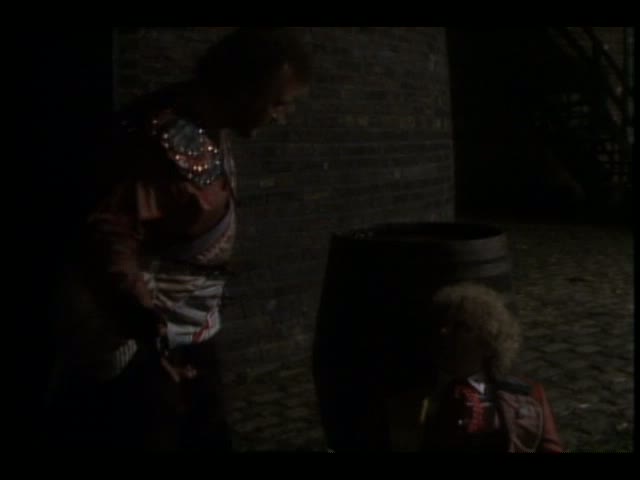
Doctor: Peter Davison (5th Doctor)
Companion: Peri
Written by: Robert Holmes
Directed by: Graeme Harper
Background & Significance: Robert Holmes is one of the three greatest Doctor Who writers of all time,
which is rather fortunate because he also happens to be the most
prolific, writing seventy two of the Classic series' original
almost-seven-hundred episode run (which, by the way, is over ten percent
of all Classic episodes). Throw in the lot that he oversaw as script editor and
that number balloons to one hundred forty four (which is almost 20% of
all Doctor Who episodes ever produced). His run was so
long and prolific, in fact, it can be broken down into stages: two Troughton
era stories (where he got his feet wet), to four classic Pertwee stories
(which allowed him playing ground to experiment with different types of
stories) to his run at script editor when he shaped and created (in a
sense) Tom Baker's Doctor (during which he wrote five stories), to his
few dabbles in the post-him Tom Baker era, to his long break where he
didn't write any Doctor Who stories for five years, to his
triumphant return with "The Caves of Androzani" and his final Colin
Baker stories, which were landmarks and such. In a lot of ways, he
reminds me of The Modern Era's Steven Moffat in that Moffat got his feet
wet during Eccleston, played around with different stories during
Tennant, and then took over the show for a new Doctor when Tennant left.
Both men created/are creating classic, popular foes that are known for
being scary, wrote tremendously famous/popular stories, and they both
are proven to be idea factories through and through.
But "The Caves of Androzani" is his unabashed masterpiece.
We've been talking about Holmes a lot lately. Hell, this is the fourth story penned by Holmes in the past two months, but this is one that's... special. It's the only time Holmes ever wrote for the 5th Doctor and it was his last opportunity to because this is Holmes's opportunity to write a Doctor's regeneration story. Indeed, it really brings him full circle because his bursting onto the scene happened in Jon Pertwee's first story (so he did a post-regen story) after two stories of warm-up. And this is his last story before (essentially) two stories of cool-down (if you count "Trial" as one big monolithic story). It also makes Holmes relatively unique, as he's one of only three other writers (Terrence Dicks, Christopher Bidmead, and Russell T. Davies) to write both a regeneration story (that is, a story that ends in regeneration) and a post-regeneration story (that is, a story that picks up immediately after The Doctor's regeneration).
"Androzani" came about because Eric Saward (having gone back through the Doctor Who archives) became enamored with Holmes and looked for a way to get Holmes back to write a story for Doctor Who again. Somehow Holmes (who apparently thought he'd been away for long enough) and Nathan-Turner (who disliked bringing in people who had been around on the program longer than him and who could thus undermine his authority) both got on board and there was an attempt to get Holmes to write the 20th Anniversary special (what eventually became "The Five Doctors"). Holmes found the laundry list of things to include (Cybermen, a Dalek, Time Lords, Gallifrey, The Master, and Five Doctors) untenable and stepped down from scripting duties. But Saward, not wanting to let go of a good thing and desperate to get Holmes's quality into his own run on the show, managed to persuade Nathan-Turner to bring Holmes in for a different story. That story became, eventually, "The Caves of Androzani", The 5th Doctor's final story.
It's not all about Holmes, though. This story also marks the first behind-the-camera effort for Graeme Harper, who is, for my money, the best Doctor Who director of all time, and this is the first thing he'd ever directed. Ever. He'd been around the show (and other shows) as an assistant at various levels (working under Douglas Camfield at one point). If you know the name, you know for a fact this is not the last thing he directed either and that he went on to do not only "Revelation of the Daleks" but a number of stories during the David Tennant years (including the Cybermen stories in series two, "Utopia" in series three, series four's finale of "Stolen Earth/Journey's End", the exquisite "Waters of Mars", and a bunch of other programs like the BBC's most recent adaptation of Robin Hood.
But this is the first thing he ever directed, so I guess it's worth seeing if he puts his back into it and if there's any hints of a great director in here who might one day blossom into someone fantastic amazing.
I suppose I should also mention that in that Doctor Who Mighty 200 poll this came out at the very very top. So it is considered (at least as of 2009) as the fan-consensus greatest Doctor Who story ever produced. So no pressure there. That poll is basically just saying that this story is better than every single other Doctor Who story we've ever yet talked about. That's a tall order and with fifty years of television stories I'd say... well... it's worth discussing whether or not this is the best Doctor Who story ever. Granted, I know my own thoughts based on the one previous time I've watched this. I'm just wondering if this will confirm or adjust them.
So let's get to it!
Showing posts with label Robert Holmes. Show all posts
Tuesday, December 18, 2012
Tuesday, December 4, 2012
Serial 84: The Brain of Morbius
Doctor: Tom Baker (4th Doctor)
Companion: Sarah Jane Smith
Written by: Robin Bland (a.k.a Terrance Dicks and Robert Holmes)
Directed by: Christopher Barry
Background & Significance: Season 13 of Doctor Who is perhaps one of the best seasons of television the show ever experienced. After a season of stories coordinated by the previous production team, this new start allowed Holmes to sculpt the show into whatever he wanted it to be. As we've discussed previously, this resulted in a season full of horror pastiches and sendups. Mummies, mutant plants, shapeshifters, body snatchers...
And now? Frankenstein.
"Brain of Morbius" comes at the exact halfway point of their era and represents the pinnacle of the Hinchcliffe/Holmes vision for the show. Originally written by Terrance Dicks (the original version had an aesthetically-challenged robot that cobbled together a body for the wrecked Morbius based on its own warped view of human anatomy), it was eventually almost completely re-written by Robert Holmes, so much so that Dicks asked his name be removed from the writing credit. As such, it's really a Holmesian contribution to Doctor Who and to say otherwise is massive, massive self-deception (as we'll discuss) because... well... it's a Holmes story, isn't it?
So let's get to it!
Companion: Sarah Jane Smith
Written by: Robin Bland (a.k.a Terrance Dicks and Robert Holmes)
Directed by: Christopher Barry
Background & Significance: Season 13 of Doctor Who is perhaps one of the best seasons of television the show ever experienced. After a season of stories coordinated by the previous production team, this new start allowed Holmes to sculpt the show into whatever he wanted it to be. As we've discussed previously, this resulted in a season full of horror pastiches and sendups. Mummies, mutant plants, shapeshifters, body snatchers...
And now? Frankenstein.
"Brain of Morbius" comes at the exact halfway point of their era and represents the pinnacle of the Hinchcliffe/Holmes vision for the show. Originally written by Terrance Dicks (the original version had an aesthetically-challenged robot that cobbled together a body for the wrecked Morbius based on its own warped view of human anatomy), it was eventually almost completely re-written by Robert Holmes, so much so that Dicks asked his name be removed from the writing credit. As such, it's really a Holmesian contribution to Doctor Who and to say otherwise is massive, massive self-deception (as we'll discuss) because... well... it's a Holmes story, isn't it?
So let's get to it!
Tuesday, November 20, 2012
Serial 140: The Two Doctors
Doctor: Colin Baker (6th Doctor), Patrick Troughton (2nd Doctor)
Companion: Peri Brown, Jamie McCrimmon
Written by: Robert Holmes
Directed by: Peter Moffat
Background & Significance: In 1985 Doctor Who turned twenty two. So it was a few years past the 20th and still a few years from the 25th. Other than that, it's not really that remarkable. Sure, I suppose it's the sole season featuring Colin Baker as The Doctor. Compared to the previous twenty two, his twenty third is positively abbreviated, so it's hard to count that in my head. This was his first proper season. Other than that, there's nothing special or remarkable about it, is there?
And yet here we are talking about a multi-Doctor crossover.
Given the rousing success with which Robert Holmes had written "The Caves of Androzani", Eric Saward was quick to hire him back for another go at some Doctor Who. John Nathan-Turner (capable of knowing how good "Androzani" was and being not unintelligent) was quick to acquiesce to the idea. So we have the return of Robert Holmes offering one of his last stories for one of the most... marmite seasons of Doctor Who ever. And he was given a laundry list of things to do: bring in the 2nd Doctor. And Jamie. And Sontarans. Oh and set it in America. We're thinking New Orleans, because that lines up with your desire to do a story about food.
It was soon changed from Seville from New Orleans because the location filming fell through. And honestly, why not Spain?
But the point stands that this story had a laundry list of things to accomplish and Holmes had three whole episodes (the equivalent of a six parter in the old, 25-minute episode days) with which to incorporate all his ideas. And is it too much? Perhaps? How does Holmes react to the violence and intensity that he helped usher in with "Androzani"? How does he handle all of these elements and how does Colin Baker do? So many thoughts. I mean, well, we haven't talked about C. Baker in a god damn age. And it'll be the last time we talk about him. Sad.
So let's get to it!
Companion: Peri Brown, Jamie McCrimmon
Written by: Robert Holmes
Directed by: Peter Moffat
Background & Significance: In 1985 Doctor Who turned twenty two. So it was a few years past the 20th and still a few years from the 25th. Other than that, it's not really that remarkable. Sure, I suppose it's the sole season featuring Colin Baker as The Doctor. Compared to the previous twenty two, his twenty third is positively abbreviated, so it's hard to count that in my head. This was his first proper season. Other than that, there's nothing special or remarkable about it, is there?
And yet here we are talking about a multi-Doctor crossover.
Given the rousing success with which Robert Holmes had written "The Caves of Androzani", Eric Saward was quick to hire him back for another go at some Doctor Who. John Nathan-Turner (capable of knowing how good "Androzani" was and being not unintelligent) was quick to acquiesce to the idea. So we have the return of Robert Holmes offering one of his last stories for one of the most... marmite seasons of Doctor Who ever. And he was given a laundry list of things to do: bring in the 2nd Doctor. And Jamie. And Sontarans. Oh and set it in America. We're thinking New Orleans, because that lines up with your desire to do a story about food.
It was soon changed from Seville from New Orleans because the location filming fell through. And honestly, why not Spain?
But the point stands that this story had a laundry list of things to accomplish and Holmes had three whole episodes (the equivalent of a six parter in the old, 25-minute episode days) with which to incorporate all his ideas. And is it too much? Perhaps? How does Holmes react to the violence and intensity that he helped usher in with "Androzani"? How does he handle all of these elements and how does Colin Baker do? So many thoughts. I mean, well, we haven't talked about C. Baker in a god damn age. And it'll be the last time we talk about him. Sad.
So let's get to it!
Tuesday, October 23, 2012
Serial 95: The Sun Makers
Doctor: Tom Baker (4th Doctor)
Companions: Leela
Written by: Robert Holmes
Directed by: Pennant Roberts
Editor's Note: Hallo hallo! Dropping in to point out that this is Cassandra's last entry! Lordie lord we are racing towards an ending and quickly, aren't we? By golly we are. But yes. Here's Cassandra with some discussion on "The Sun Makers".
Background & Significance: So the name of this game is 'satire'.
When I watched this story for the first time, the point flew right over my head and so I ended up disliking it. "Robert Holmes?" I thought. "Oh, surely this shall be another heavy masterpiece." And it's not, so, I was confused and felt a bit betrayed and let down, since this was the last Robert Holmes story we did on our initial watch-through.
But just because this is much lighter fair than what I've come to expect from Holmes, doesn't make it bad. On the contrary, it really shows off his range as a writer, as good comedy is one of the hardest things to master.
And this is a comedy. It's a very biting satire on Imperialism and Colonialism as well as the British equivalent of the IRS, which I think is hilarious. Granted, there are some dark elements/moments that we'll talk about in a bit, but at its heart this is a comedy, which makes it fit in splendidly with the Williams era aesthetic.
This is also one of the last stories featuring Leela as a companion, which makes me really sad because I love Leela and I think she's really great here, which may or may not have something to do with the return of Pennant Roberts, who also directed Leela's debut story "The Face of Evil".
But enough of all that, let's take a closer look, shall we?
Companions: Leela
Written by: Robert Holmes
Directed by: Pennant Roberts
Editor's Note: Hallo hallo! Dropping in to point out that this is Cassandra's last entry! Lordie lord we are racing towards an ending and quickly, aren't we? By golly we are. But yes. Here's Cassandra with some discussion on "The Sun Makers".
Background & Significance: So the name of this game is 'satire'.
When I watched this story for the first time, the point flew right over my head and so I ended up disliking it. "Robert Holmes?" I thought. "Oh, surely this shall be another heavy masterpiece." And it's not, so, I was confused and felt a bit betrayed and let down, since this was the last Robert Holmes story we did on our initial watch-through.
But just because this is much lighter fair than what I've come to expect from Holmes, doesn't make it bad. On the contrary, it really shows off his range as a writer, as good comedy is one of the hardest things to master.
And this is a comedy. It's a very biting satire on Imperialism and Colonialism as well as the British equivalent of the IRS, which I think is hilarious. Granted, there are some dark elements/moments that we'll talk about in a bit, but at its heart this is a comedy, which makes it fit in splendidly with the Williams era aesthetic.
This is also one of the last stories featuring Leela as a companion, which makes me really sad because I love Leela and I think she's really great here, which may or may not have something to do with the return of Pennant Roberts, who also directed Leela's debut story "The Face of Evil".
But enough of all that, let's take a closer look, shall we?
Tuesday, September 4, 2012
Serial 55: Terror of the Autons
Doctor: Jon Pertwee (3rd Doctor)Companions: Jo Grant
Written by: Robert Holmes
Directed by: Barry Letts
Editor's Note: Hey, kids! I'm back with a quick quick intro to point out that Cassandra is on board to talk about some Autons today. It's a doozy of a story with a lot of moving pieces, and I honestly felt good about giving it up because there's still a bunch of great stories left to do so why not share the wealth? And with this story we're in the last four months of the blog! Hoo-rah!
But for now, I leave you with Cassandra...
Background & Significance: So the announcement of Season 8 was a pretty big deal for Barry Letts and Terrance Dicks.
Due to the nature of Doctor Who's production scheduling, and how a creative changing of the guard takes some time, Letts didn't really get a chance to make much of a mark on Season 7. However, with the advent of Season 8, there were quite a few changes.
Among these changes were the introduction of a gimmick of some sort to get new audiences tuning in to watch. This gimmick arrived in the form of the Master, a Moriarty to the Doctor's Sherlock Holmes. Letts and Dicks hoped that the Master might overtake the Daleks as the top foe for the Doctor, and aimed to include the Master in each of the 5 stories in Season 8.
Another change was the decision to not bring back companion Liz Shaw, who was deemed too independent to really work well with the Doctor. The decision was made to bring on a male/female team reminiscent of Jaime and Victoria in the form of Jo Grant, who would assist the Doctor, and Captain Mike Yates, The Brigadier's second in command. There were even plans for the hint of romantic possibility between the two, and it totally shows (and oh man, I ship them so hard).
Written by Robert Holmes and directed by Barry Letts, "Terror of the Autons" promises to be something fantastic, especially on a rewatch. I'm excited. Are you excited? Because I am.
But enough of all that, let's take a closer look, shall we?
Tuesday, April 10, 2012
Serial 47: The Krotons
Doctor: Patrick Troughton (2nd Doctor)
Companions: Jamie, Zoe
Written by: Robert Holmes
Directed by: David Maloney
Background & Significance: If you know me, or how I talk about Doctor Who, you know that the way I come into the show is based almost entirely around writing and the way in which Doctor Who is constructed. A lot of that is down to the writers because they are (in so many ways so many people could never understand) possibly the most important linchpin to any creative endeavor. Without the writer, there is nothing.
I say all this to underline the fascination I have with "The Krotons". Which (for those not in the know) is the first Doctor Who story that Robert Holmes ever wrote.
Produced as the "middle serial" of season six, it's worth pointing out that this is the last story of the first half of Patrick Troughton's last season. By this point, the burnout factor of Doctor Who in the 1960s was starting to take its toll on the show. And hey, who can blame them? This isn't a soap opera with the fortitude to produce THAT many episodes, and this was the sixth year in a row that Doctor Who had produced forty or more episodes. So everyone was tired and really pushing forward to just finish out the season by any means necessary so they could get to the colour and the UNIT and the producing 26ish episodes a year as opposed to the usual 40+. It was at this time that Derrick Sherwin stepped aside as script editor to help Doctor Who in other ways, making way for his assistant Terrance Dicks to step in and drive the script editing for the show...
And wouldn't you know it, but it was at this same time that Robert Holmes jumped into the picture.
Now Toby Hadoke mentions this in Running Through Corridors, but it bears repeating here: it's interesting that two of the three most influential writers in Classic Doctor Who made their first appearance around this time, almost six years into the show's existence. And it's interesting how the two were almost meant to write the show. According to reports, Holmes's initial draft for this story was turned in almost two months early and rushed into production when the original story assigned to this production ("The Prison in Space") bowed out due to the writer not getting along with notes (or something; don't quote me on that). And really, who turns in a draft so early without someone pointing at him and saying "Damn. He might be something?"
"The Krotons" is his first story, and it's one of the first stories directed by David Maloney, who would go on to direct some fantastic other ones (don't worry, you've seen them) and had already previously directed "The Mind Robber", and it's interesting how it's overlooked/forgotten, or that Robert Holmes outright wrote for five different Doctors on television, but how Holmes's real work on the show almost really doesn't start until he introduces the 3rd Doctor and starts getting all Holmesy. Think of this and "The Space Pirates" as... trial runs, almost. That's not to say they're not good, but I'd hardly consider "The Krotons" indicative of what Holmes would write later ("Mysterious Planet" notwithstanding, but I'll discuss that I guess). No. "Spearhead" is almost a better fresh start to say "look at this guy stumbling onto the scene with some geniusness".
And yet, "The Krotons" is his first. And it's... Well... I think we should talk about it.
So let's get to it!
I say all this to underline the fascination I have with "The Krotons". Which (for those not in the know) is the first Doctor Who story that Robert Holmes ever wrote.
Produced as the "middle serial" of season six, it's worth pointing out that this is the last story of the first half of Patrick Troughton's last season. By this point, the burnout factor of Doctor Who in the 1960s was starting to take its toll on the show. And hey, who can blame them? This isn't a soap opera with the fortitude to produce THAT many episodes, and this was the sixth year in a row that Doctor Who had produced forty or more episodes. So everyone was tired and really pushing forward to just finish out the season by any means necessary so they could get to the colour and the UNIT and the producing 26ish episodes a year as opposed to the usual 40+. It was at this time that Derrick Sherwin stepped aside as script editor to help Doctor Who in other ways, making way for his assistant Terrance Dicks to step in and drive the script editing for the show...
And wouldn't you know it, but it was at this same time that Robert Holmes jumped into the picture.
Now Toby Hadoke mentions this in Running Through Corridors, but it bears repeating here: it's interesting that two of the three most influential writers in Classic Doctor Who made their first appearance around this time, almost six years into the show's existence. And it's interesting how the two were almost meant to write the show. According to reports, Holmes's initial draft for this story was turned in almost two months early and rushed into production when the original story assigned to this production ("The Prison in Space") bowed out due to the writer not getting along with notes (or something; don't quote me on that). And really, who turns in a draft so early without someone pointing at him and saying "Damn. He might be something?"
"The Krotons" is his first story, and it's one of the first stories directed by David Maloney, who would go on to direct some fantastic other ones (don't worry, you've seen them) and had already previously directed "The Mind Robber", and it's interesting how it's overlooked/forgotten, or that Robert Holmes outright wrote for five different Doctors on television, but how Holmes's real work on the show almost really doesn't start until he introduces the 3rd Doctor and starts getting all Holmesy. Think of this and "The Space Pirates" as... trial runs, almost. That's not to say they're not good, but I'd hardly consider "The Krotons" indicative of what Holmes would write later ("Mysterious Planet" notwithstanding, but I'll discuss that I guess). No. "Spearhead" is almost a better fresh start to say "look at this guy stumbling onto the scene with some geniusness".
And yet, "The Krotons" is his first. And it's... Well... I think we should talk about it.
So let's get to it!
Tuesday, November 29, 2011
Serial 91: The Talons of Weng-Chiang
Doctor: Tom Baker (4th Doctor)
Companion: Leela
Written by: Robert Holmes
Directed by: David Maloney
Background & Significance: In 1976, as producer Phillip Hinchcliffe and script editor Robert Holmes were going to wrap their third season as a team, it became obvious to the two of them that Hinchcliffe was being moved away to a new show and that Robert Holmes would most likely be going with him. Holmes, of course, did end up leaving four stories later (subsequent producer Graham Williams asked him to stay on), but in terms of the geniusness that was Hinchcliffe's oversight, this was it, and when it comes to Holmes, this (in a lot of ways) was it for him for a while.
All of this is adds up to the fact that "The Talons of Weng-Chiang" is a wonderfully important and meaningful story. And if it's not that way to anyone else (how many times do we have to talk about the racism again? Fine, fine. I will too) it certainly is to me.
In a lot of ways, "The Talons of Weng-Chiang" is the thesis project for both Hinchcliffe and Holmes and carries all of the trademarks they picked up over the course of their three years running the show. Indeed, Hinchcliffe's first instruction to Holmes was "write anything you want, just don't include The Master" (which Holmes, at one point, wanted to do), giving Robert Holmes free reign to write anything he wanted. This, of course, led to Holmes dialing into the Gothic horror he'd been injecting into the show, only he dialed it up by eleven. He grabbed books and books off the shelf, injecting everything from Phantom of the Opera to Sherlock Holmes to Fu Manchu. He brought in his classic double act, making, perhaps, the most famous double act he ever did (who, by the way, Hinchcliffe seriously considered spinning off into their own series, which would actually happen eventually and to much acclaim), set it in Victorian times (which was the only thing his era was lacking when you really look at it), homaged Jack the Ripper, created a VERY Robert Holmesian villain, and made The Doctor Sherlock Holmes.
Hinchcliffe, of course, didn't care anymore. Well, I mean he did care. He was still producer and he'd had a very good run, but he wanted to go out on a bang (and did in a way very few others have), by making the very best Doctor Who story he could. So when I say he didn't care, I mean he didn't care about silly things like "budget" anymore. His vision for Doctor Who had always run up against budgetary concerns, but this time he threw it all out the window and made it lavish and gorgeous and the best it could possibly be. He brought in David Maloney (of "Mind Robber", "War Games", "Genesis of the Daleks", and "Deadly Assassin" fame) for his final ever work on Doctor Who, authorized night shoots, and told everyone to go crazy and make the best show they possibly could.
As it turns out, when you're running what's probably the best Doctor Who era ever and you tell everyone to make the best story and give them the freedom to do so, it'd be pretty hard to mess that up. And they really don't. It's astounding how much this really ends up being the perfect ending for their era, a climax and zenith that Doctor Who had very rarely reached or would reach again. And for most everyone to agree that this story is easily the best of the Hinchcliffe/Holmes when quality of the era is as high as it is (and in case you've forgotten, go back and see all of the Hinchcliffe/Holmes stories there's been and look at how high a bar they set), that's really saying something. Really truly.
Also, as a heads up this is probably going to be a love fest. I can already feel it coming, but hey. It's the hundredth story we're reviewing on the blog. I say we do it right.
So let's get to it!
Companion: Leela
Written by: Robert Holmes
Directed by: David Maloney
Background & Significance: In 1976, as producer Phillip Hinchcliffe and script editor Robert Holmes were going to wrap their third season as a team, it became obvious to the two of them that Hinchcliffe was being moved away to a new show and that Robert Holmes would most likely be going with him. Holmes, of course, did end up leaving four stories later (subsequent producer Graham Williams asked him to stay on), but in terms of the geniusness that was Hinchcliffe's oversight, this was it, and when it comes to Holmes, this (in a lot of ways) was it for him for a while.
All of this is adds up to the fact that "The Talons of Weng-Chiang" is a wonderfully important and meaningful story. And if it's not that way to anyone else (how many times do we have to talk about the racism again? Fine, fine. I will too) it certainly is to me.
In a lot of ways, "The Talons of Weng-Chiang" is the thesis project for both Hinchcliffe and Holmes and carries all of the trademarks they picked up over the course of their three years running the show. Indeed, Hinchcliffe's first instruction to Holmes was "write anything you want, just don't include The Master" (which Holmes, at one point, wanted to do), giving Robert Holmes free reign to write anything he wanted. This, of course, led to Holmes dialing into the Gothic horror he'd been injecting into the show, only he dialed it up by eleven. He grabbed books and books off the shelf, injecting everything from Phantom of the Opera to Sherlock Holmes to Fu Manchu. He brought in his classic double act, making, perhaps, the most famous double act he ever did (who, by the way, Hinchcliffe seriously considered spinning off into their own series, which would actually happen eventually and to much acclaim), set it in Victorian times (which was the only thing his era was lacking when you really look at it), homaged Jack the Ripper, created a VERY Robert Holmesian villain, and made The Doctor Sherlock Holmes.
Hinchcliffe, of course, didn't care anymore. Well, I mean he did care. He was still producer and he'd had a very good run, but he wanted to go out on a bang (and did in a way very few others have), by making the very best Doctor Who story he could. So when I say he didn't care, I mean he didn't care about silly things like "budget" anymore. His vision for Doctor Who had always run up against budgetary concerns, but this time he threw it all out the window and made it lavish and gorgeous and the best it could possibly be. He brought in David Maloney (of "Mind Robber", "War Games", "Genesis of the Daleks", and "Deadly Assassin" fame) for his final ever work on Doctor Who, authorized night shoots, and told everyone to go crazy and make the best show they possibly could.
As it turns out, when you're running what's probably the best Doctor Who era ever and you tell everyone to make the best story and give them the freedom to do so, it'd be pretty hard to mess that up. And they really don't. It's astounding how much this really ends up being the perfect ending for their era, a climax and zenith that Doctor Who had very rarely reached or would reach again. And for most everyone to agree that this story is easily the best of the Hinchcliffe/Holmes when quality of the era is as high as it is (and in case you've forgotten, go back and see all of the Hinchcliffe/Holmes stories there's been and look at how high a bar they set), that's really saying something. Really truly.
Also, as a heads up this is probably going to be a love fest. I can already feel it coming, but hey. It's the hundredth story we're reviewing on the blog. I say we do it right.
So let's get to it!
Tuesday, July 5, 2011
Serial 49: The Space Pirates
Doctor: Patrick Troughton (2nd Doctor)
Companions: Jamie, Zoe
Writtten by: Robert Holmes
Directed by: Michael Hart
Background & Significance: "The Space Pirates" will forever be remembered as "The One Before The War Games", and that's not just because "The War Games" is so influential and spanning and all-important. The regulars and the cast and crew themselves were in a bit of a transitionary phase while the show prepared to undergo what was essentially a square one reboot.
By season six, Patrick Troughton's final season, Doctor Who as a show was starting to become a bit tired. Nevermind Troughton himself, who cited the rigorous television schedule as grueling and tiring without any prompting from anyone else, but to have a show like Doctor Who with all its scifiness and special effects and shooting schedules etc. produce an average of over forty two stories per year, week in, week out for six years would be exhausting to any production team, and it's no wonder, therefore, that the show needed to slow down and take measure of itself and return to a place of quality or what have you. So in a lot of ways, "The War Games" becomes the last final sprint of what was essentially (at that point) weekly Doctor Who, and its quality reflects that last, final burst of energy to get it across the finish line, almost atypical in how frakking good it ended up being.
And that leaves "The Space Pirates", which is essentially the shadow of that tired show limping along before that final burst of speed.
When you start to get into the nitty gritty of Troughton's final season, it's clear to see that the production crew was absolutely languishing. "The Dominators" was supposed to be six episodes, but they trimmed it to five to enhance the quality of the remaining story. "The Invasion" was as long as it was to stall for time as other things got ready. Doctor Who legend Terrence Dicks (arguably one of the most important figures in Doctor Who's history) was emergency-promoted from assistant script editor to script editor due to outgoing script editor Derrick Sherwin's continued influence in becoming producer on the show. Dicks himself was pulled off of script editing duties towards the end of the season to co-write "The War Games" with Malcolm Hulke with Sherwin stepping in to fill in for this story, "The Space Pirates", and because of the massive scope and the finale's ten episode length, The Doctor and his companions had to pre-film their contribution to episode six.
Clearly, the behind-the-scenes of Doctor Who by this point was just... a nightmare, trying to keep the ship afloat long enough to make it to the complete relaunch with "Spearhead From Space".
Sorry. I'm rambling. Anyways...
"The Space Pirates" is writer Robert Holmes's second contribution to Doctor Who after a strong initial outing in "The Krotons". Unfortunately, "The Krotons" was meant to be the penultimate story for season six, but when the planned fourth story of the season had to be abandoned, "The Krotons" was pushed up to take its place and "The Space Pirates" was born to fill the spot left by "The Krotons." (See? Season six. Huge mess.)
The story itself is one that isn't regarded too strongly by the fandom. Most infamously for most, The Doctor and his companions don't show up until fifteen minutes into the first episode and then stays largely removed from most of the action until well into the third episode. There's probably many reasons for this, not the least of which is Holmes's own recollection that he turned in a four-part story and then was quickly asked to expand it into six parts. That alone sets off warning bells in my head, but my god... Talk about the signs of age and just stretching things out until they can make it to that glorious glorious finale and everyone can sleep a bit more.
But enough talking about silly politics. We're here to talk about some god damn Space Pirates! (Or are we?)
Companions: Jamie, Zoe
Writtten by: Robert Holmes
Directed by: Michael Hart
Background & Significance: "The Space Pirates" will forever be remembered as "The One Before The War Games", and that's not just because "The War Games" is so influential and spanning and all-important. The regulars and the cast and crew themselves were in a bit of a transitionary phase while the show prepared to undergo what was essentially a square one reboot.
By season six, Patrick Troughton's final season, Doctor Who as a show was starting to become a bit tired. Nevermind Troughton himself, who cited the rigorous television schedule as grueling and tiring without any prompting from anyone else, but to have a show like Doctor Who with all its scifiness and special effects and shooting schedules etc. produce an average of over forty two stories per year, week in, week out for six years would be exhausting to any production team, and it's no wonder, therefore, that the show needed to slow down and take measure of itself and return to a place of quality or what have you. So in a lot of ways, "The War Games" becomes the last final sprint of what was essentially (at that point) weekly Doctor Who, and its quality reflects that last, final burst of energy to get it across the finish line, almost atypical in how frakking good it ended up being.
And that leaves "The Space Pirates", which is essentially the shadow of that tired show limping along before that final burst of speed.
When you start to get into the nitty gritty of Troughton's final season, it's clear to see that the production crew was absolutely languishing. "The Dominators" was supposed to be six episodes, but they trimmed it to five to enhance the quality of the remaining story. "The Invasion" was as long as it was to stall for time as other things got ready. Doctor Who legend Terrence Dicks (arguably one of the most important figures in Doctor Who's history) was emergency-promoted from assistant script editor to script editor due to outgoing script editor Derrick Sherwin's continued influence in becoming producer on the show. Dicks himself was pulled off of script editing duties towards the end of the season to co-write "The War Games" with Malcolm Hulke with Sherwin stepping in to fill in for this story, "The Space Pirates", and because of the massive scope and the finale's ten episode length, The Doctor and his companions had to pre-film their contribution to episode six.
Clearly, the behind-the-scenes of Doctor Who by this point was just... a nightmare, trying to keep the ship afloat long enough to make it to the complete relaunch with "Spearhead From Space".
Sorry. I'm rambling. Anyways...
"The Space Pirates" is writer Robert Holmes's second contribution to Doctor Who after a strong initial outing in "The Krotons". Unfortunately, "The Krotons" was meant to be the penultimate story for season six, but when the planned fourth story of the season had to be abandoned, "The Krotons" was pushed up to take its place and "The Space Pirates" was born to fill the spot left by "The Krotons." (See? Season six. Huge mess.)
The story itself is one that isn't regarded too strongly by the fandom. Most infamously for most, The Doctor and his companions don't show up until fifteen minutes into the first episode and then stays largely removed from most of the action until well into the third episode. There's probably many reasons for this, not the least of which is Holmes's own recollection that he turned in a four-part story and then was quickly asked to expand it into six parts. That alone sets off warning bells in my head, but my god... Talk about the signs of age and just stretching things out until they can make it to that glorious glorious finale and everyone can sleep a bit more.
But enough talking about silly politics. We're here to talk about some god damn Space Pirates! (Or are we?)
So let's get to it!
Tuesday, March 1, 2011
Serial 76: The Ark in Space
Doctor: Tom Baker (4th Doctor)
Companion: Sarah Jane Smith, Harry Sullivan
Written by: Robert Holmes (and John Lucarotti)
Directed by: Rodney Bennett
A note: Hey everyone! So, as you probably know if you're reading this, it's March, which means that I've been doing this blog for a whole year (also, Cassandra! Hi, Cassandra! (She helped)). Haven't missed a week (miraculously), so I think it's time for an anniversary celebration. To kick things off, I'm talking about the real start to the Hinchcliffe/Holmes era with a Robert Holmes story, but the fun doesn't stop there! We've got Troughton next week, the story that started it all the week after that, and then a regeneration trilogy I've been looking forward to talking about for a long time. Thanks for all your support over the past twelve months, thanks for sticking around in the tickling of my fancy, and most of all, thanks for reading. Means the world.
Background & Significance: If you were to ever talk about Tom Baker, you'd almost have to start here.
While "Robot" started off Tom Baker's first season and kicked off his seven year run, it still doesn't have the feeling of awesome that is the legendary Gothic Era under Phillip Hinchcliffe and Robert Holmes. I talked about this back when I reviewed the story, but "Robot" is a very different story in terms of tone and feature. It's a UNIT story, it's a little silly-goofy, it's very much got the silly campy feel of the Pertwee era, etc. etc. Sure, there's the script editing of Robert Holmes, but the story was still being guided by the influence of producer Barry Letts and it's written by Terrance Dicks, who had just overseen five years of UNIT stories, so the formula was in-built.
It only makes sense, then, that the next story, the first one overseen by Phillip Hinchcliffe, is where the era really starts.
"The Ark in Space" came from an idea by John Lucarotti, who had previously written such widely acclaimed historical Doctor Who stories such as "The Aztecs" and "Marco Polo". He'd been away from the show since the Hartnell era (that's almost ten years) and Holmes invited him back on the recommendation of outgoing script editor Terrance Dicks. Unfortunately, for whatever reason, the script came out less well than Holmes had hoped and (due to Lucarotti's living on a houseboat and problems with the postal service (both of which were, admittedly, beyond the show's control)), the script became unusable. Because they were set to wheels up on filming soon, Holmes scrapped Lucarotti's drafts and most of his ideas (excepting that of the titular "Ark in Space") and set about writing the damn thing himself because he just couldn't wait anymore.
He wrote the whole four-part story in eighteen days.
Magic. Serious magic. And to see this thing turn into a pretty stunning story is pretty awesome. It's also a wonderful tonal and thematic gateway into what would be a staple of Hinchcliffe/Holmes Doctor Who: great scifi ideas, heavy horror, thematic darkness. It's certainly not as much as the show would get in just a few stories, but their era certainly starts here. Even coming off of "Robot", this story is so different, different from anything seen on the show in about five years. It's one of the all-time classics and it's become a cornerstone of Doctor Who's overarching mythology; even Starship UK and Liz X are byproducts of the solar flares devastating Earth.
Not only that, but it's because of the absolute quality of this story that Holmes gets such free reign later on. Hinchcliffe (very famously) trusted Holmes's style and sensibilities and often encouraged Holmes to do page-one rewrites if he thought the story not up to snuff. This, of course, wasn't very popular with the BBC, which discouraged script editors from writing for their own show. Hinchcliffe, however, eventually fought for and won Holmes's right to write two stories per season. And without that, we wouldn't have "The Deadly Assassin" or "The Talons of Weng-Chiang".
Without those (or the other stories Holmes wrote or re-wrote from top to bottom), this era wouldn't be nearly the era that it was. And that would be sad. But that all comes from this. And thank goodness for that.
So let's get to it!
Companion: Sarah Jane Smith, Harry Sullivan
Written by: Robert Holmes (and John Lucarotti)
Directed by: Rodney Bennett
A note: Hey everyone! So, as you probably know if you're reading this, it's March, which means that I've been doing this blog for a whole year (also, Cassandra! Hi, Cassandra! (She helped)). Haven't missed a week (miraculously), so I think it's time for an anniversary celebration. To kick things off, I'm talking about the real start to the Hinchcliffe/Holmes era with a Robert Holmes story, but the fun doesn't stop there! We've got Troughton next week, the story that started it all the week after that, and then a regeneration trilogy I've been looking forward to talking about for a long time. Thanks for all your support over the past twelve months, thanks for sticking around in the tickling of my fancy, and most of all, thanks for reading. Means the world.
Background & Significance: If you were to ever talk about Tom Baker, you'd almost have to start here.
While "Robot" started off Tom Baker's first season and kicked off his seven year run, it still doesn't have the feeling of awesome that is the legendary Gothic Era under Phillip Hinchcliffe and Robert Holmes. I talked about this back when I reviewed the story, but "Robot" is a very different story in terms of tone and feature. It's a UNIT story, it's a little silly-goofy, it's very much got the silly campy feel of the Pertwee era, etc. etc. Sure, there's the script editing of Robert Holmes, but the story was still being guided by the influence of producer Barry Letts and it's written by Terrance Dicks, who had just overseen five years of UNIT stories, so the formula was in-built.
It only makes sense, then, that the next story, the first one overseen by Phillip Hinchcliffe, is where the era really starts.
"The Ark in Space" came from an idea by John Lucarotti, who had previously written such widely acclaimed historical Doctor Who stories such as "The Aztecs" and "Marco Polo". He'd been away from the show since the Hartnell era (that's almost ten years) and Holmes invited him back on the recommendation of outgoing script editor Terrance Dicks. Unfortunately, for whatever reason, the script came out less well than Holmes had hoped and (due to Lucarotti's living on a houseboat and problems with the postal service (both of which were, admittedly, beyond the show's control)), the script became unusable. Because they were set to wheels up on filming soon, Holmes scrapped Lucarotti's drafts and most of his ideas (excepting that of the titular "Ark in Space") and set about writing the damn thing himself because he just couldn't wait anymore.
He wrote the whole four-part story in eighteen days.
Magic. Serious magic. And to see this thing turn into a pretty stunning story is pretty awesome. It's also a wonderful tonal and thematic gateway into what would be a staple of Hinchcliffe/Holmes Doctor Who: great scifi ideas, heavy horror, thematic darkness. It's certainly not as much as the show would get in just a few stories, but their era certainly starts here. Even coming off of "Robot", this story is so different, different from anything seen on the show in about five years. It's one of the all-time classics and it's become a cornerstone of Doctor Who's overarching mythology; even Starship UK and Liz X are byproducts of the solar flares devastating Earth.
Not only that, but it's because of the absolute quality of this story that Holmes gets such free reign later on. Hinchcliffe (very famously) trusted Holmes's style and sensibilities and often encouraged Holmes to do page-one rewrites if he thought the story not up to snuff. This, of course, wasn't very popular with the BBC, which discouraged script editors from writing for their own show. Hinchcliffe, however, eventually fought for and won Holmes's right to write two stories per season. And without that, we wouldn't have "The Deadly Assassin" or "The Talons of Weng-Chiang".
Without those (or the other stories Holmes wrote or re-wrote from top to bottom), this era wouldn't be nearly the era that it was. And that would be sad. But that all comes from this. And thank goodness for that.
So let's get to it!
Tuesday, January 4, 2011
Serial 51: Spearhead from Space
Doctor: Jon Pertwee (3rd Doctor)
Companion: Liz Shaw
Written by: Robert Holmes
Directed by: Derek Martinus
Background & Significance: Because of the way Classic Doctor Who worked as a convention, the way the stories were told and how they were serialized individual stories but without any real overarching serialization or continuity, it's rare for a Doctor Who story to be "important". "Pyramids of Mars" can be all the fantastic in the world. Still doesn't make it "important." Important stories are typically regeneration stories (not even necessarily companion arrivals or departures because they're almost always backgrounded excepting certain instances).
"Spearhead From Space" is one of those stories that is... well... Extremely important.
For one thing, "Spearhead from Space" is the first time in Who history that the Classical-Gallifrey-favourite line "God damn, Robert Holmes" comes into play. Holmes had previously done two Doctor Who stories ("The Krotons" and "The Space Pirates"), both Patrick Troughton stories (to lesser or greater effect), but "Spearhead From Space" is the first one that really mattered in the overall scope of Doctor Who both from a Robert-Holmes-quality standpoint and from a game-changer standpoint (Holmes would later change the game with such stories as "The Ark in Space", "The Deadly Assassin", and "The Caves of Androzani").
"Spearhead from Space" is significant for a number of reasons.
It's the first Jon Pertwee serial. It's the first time Doctor Who was broadcast in colour. It's the first Doctor Who story to be entirely shot on film. It's the first story of The Doctor's five-year exile on Earth, commonly known as "The UNIT years", which was the five year run under producer Barry Letts and script editor Terrance Dicks (despite Letts's noninvolvement here (it was produced by Derrick Sherwin) it really feels like a fairly "typical" Pertwee story) And it's the introduction of one of my personal favourite villains, The Autons (and oh my god what an introduction).
And Autons aside, all of that groundbreaking firsts stuff has nothing to do with Robert Holmes (the story concepts were developed by Producer Derrick Sherwin and Script Editor Terrence Dicks, the-all-shot-on-film bits was because of a labour strike, and the colour broadcast was a BBC mandate). And yet, it's easily one of my favourite Robert Holmes stories ever. It's exquisite science fiction horror, and all of the "mandates" (specifically the introduction of possibly the show's biggest format change of the classic series: that of The Doctor being confined to Earth during the UNIT years) feels like an afterthought amidst the gorgeous distraction of this tremendous story.
So let's get to it!
Companion: Liz Shaw
Written by: Robert Holmes
Directed by: Derek Martinus
Background & Significance: Because of the way Classic Doctor Who worked as a convention, the way the stories were told and how they were serialized individual stories but without any real overarching serialization or continuity, it's rare for a Doctor Who story to be "important". "Pyramids of Mars" can be all the fantastic in the world. Still doesn't make it "important." Important stories are typically regeneration stories (not even necessarily companion arrivals or departures because they're almost always backgrounded excepting certain instances).
"Spearhead From Space" is one of those stories that is... well... Extremely important.
For one thing, "Spearhead from Space" is the first time in Who history that the Classical-Gallifrey-favourite line "God damn, Robert Holmes" comes into play. Holmes had previously done two Doctor Who stories ("The Krotons" and "The Space Pirates"), both Patrick Troughton stories (to lesser or greater effect), but "Spearhead From Space" is the first one that really mattered in the overall scope of Doctor Who both from a Robert-Holmes-quality standpoint and from a game-changer standpoint (Holmes would later change the game with such stories as "The Ark in Space", "The Deadly Assassin", and "The Caves of Androzani").
"Spearhead from Space" is significant for a number of reasons.
It's the first Jon Pertwee serial. It's the first time Doctor Who was broadcast in colour. It's the first Doctor Who story to be entirely shot on film. It's the first story of The Doctor's five-year exile on Earth, commonly known as "The UNIT years", which was the five year run under producer Barry Letts and script editor Terrance Dicks (despite Letts's noninvolvement here (it was produced by Derrick Sherwin) it really feels like a fairly "typical" Pertwee story) And it's the introduction of one of my personal favourite villains, The Autons (and oh my god what an introduction).
And Autons aside, all of that groundbreaking firsts stuff has nothing to do with Robert Holmes (the story concepts were developed by Producer Derrick Sherwin and Script Editor Terrence Dicks, the-all-shot-on-film bits was because of a labour strike, and the colour broadcast was a BBC mandate). And yet, it's easily one of my favourite Robert Holmes stories ever. It's exquisite science fiction horror, and all of the "mandates" (specifically the introduction of possibly the show's biggest format change of the classic series: that of The Doctor being confined to Earth during the UNIT years) feels like an afterthought amidst the gorgeous distraction of this tremendous story.
So let's get to it!
Thursday, December 30, 2010
Serial 146: The Ultimate Foe - The Trial of a Time Lord Part IV

Doctor: Colin Baker (6th Doctor)
Companion: Mel
Written by: Robert Holmes & Pip and Jane Baker
Directed by: Chris Clough
Background & Significance: If you count The Trial of a Time Lord as one giant serial of fourteen parts and disregard the four-story structure of it, Trial of a Time Lord is the longest Doctor Who story of all time and this last two parter is the thing that puts it over the edge.
I don't want to talk too much about the actual dynamics behind this story here because they work a little bit better as we get into it, but I can't really talk about the finale of this epicness without going into the gritty details of the behind-the-scenes, which I find terribly fascinating.
So as we mentioned back in "The Mysterious Planet", Trial of a Time Lord was the last thing Robert Holmes ever worked on. The first episode of these final two parts is the last thing Robert Holmes ever completed, and it is a MASTERPIECE. Seriously, I think it's one of my favourite single episodes of Doctor Who of all time. It's dark, elegant, creepy, and amazingly Holmesian in the best of ways. And it's as good as anything we've seen him do so far if you ask me.
Unfortunately, Holmes got incredibly sick and passed away before he could get past more than a rough outline of episode two, meaning Holmes's climactic part two is lost to us forever and we'll never get it back.
For long-time script editor Eric Saward, Holmes's death was the last straw he could take under Jonathan Nathan-Turner. He quit Doctor Who after editing "Mindwarp", but offered to write the final episode based on Holmes's original outline on the condition Nathan-Turner not make him to change anything from Holmes's original outline, which included the planned cliffhanger ending where The Doctor and The Valeyard grappled with each other and over a Time Vent and fell in. The vent closed behind them and the story ended with the fate of The Doctor left up in the air.
So Saward wrote the script and turned it in and then production on the end of Trial started. Locations were scouted, sets were built, actors entered rehearsals...
Then Nathan-Turner, for some reason, decided that the ending was too much of a downer and asked Saward to change the ending. And really, JNT. Why did you do this? You know how much Saward isn't messing around, you had agreed to the ending with enthusiasm, and everything is going good. What did you THINK would happen? Spoilers! Saward told you!
But no. Nathan-Turner did it anyways, and Saward got pissed, walked off the show for a second time, took the copyrighted script and outline with him, and refused to let Nathan-Turner use either for the final product.
So now, they're about to enter production and they have neither script nor outline on the last episode. All they have is list of locations and actors. THAT'S IT. I can't even imagine that day for JNT. Musta been awful.
With no other options, JNT (who couldn't even give the new writers any details about the original part two because of Saward's copyright) turned to Pip and Jane Baker, gave them a list of sets and locations, and asked them to write the episode. He could give them part one because it was done and turned in, but all of part two had to be their own extrapolation.
They turned around a draft in three days.
Now, after all this, did they pull it off? I mean, at this point, you gotta know if they did or not, right? You just gotta know...
So let's get to it!
Monday, December 20, 2010
Serial 143: The Mysterious Planet - The Trial of a Time Lord Part I
Doctor: Colin Baker (6th Doctor)
Companion: Peri Brown
Written by: Robert Holmes
Directed by: Nicholas Mallett
Background & Significance: I like ending things with a nice flourish. There's nothing so wrong with some cool events. This past summer it was The Key to Time. For the holiday break, we get to talk about another significant event-story in Doctor Who history. So for the next two weeks (that's two posts a week for y'all. Happy Winter indeed) we're going to talk about a highly debated and strangely controversial Doctor Who story: The Trial of a Time Lord. But first! A little background:
Now I'll be honest with you right up front. I think the concept for Trial is a bit melodramatic. The entire concept of the The Doctor on Trial comes directly from the current state of the show at the BBC because, in the mind of still-producer Jonathan Nathan-Turner, Doctor Who really was on trial. As such, I really do think it's a bit of a melodramatic concept to insert into the show. "Oh woe is us! Behold The Doctor's slow fall back to Earth as the once great show slowly falls from the graces of everyone" JNT cries, completely ignoring all the little things he did to help the show reach this point over the course of Colin Baker's run to this point (some of which we've touched upon earlier in this year, the rest of which we'll end up discussing in the coming one).
That said? Putting The Doctor on trial is a really awesome idea. As a concept, The Trial of a Time Lord has captured my imagination for quite a long time. Once I became aware of the classic series and started flipping through the collections in my local Best Buy, I remember seeing the boxsets for Trial and being completely obsessed with the concept of putting The Doctor on Trial for an entire season. And by The Time Lords no less. All of that was positively enthralling to me, but maybe that's because I love courtroom drama and never found it in my interest to avidly watch Law & Order.
But enough about my hang ups. What about the story itself?
Trial of a Time Lord is an interesting story to talk about. For one thing, it marks the dissolution of Nathan-Turner's since-first-season-of-Davison partnership with his script editor Eric Saward. It's also the swansong for the derided and notoriously unpopular Colin Baker. And it's also the last thing Robert Holmes ever worked on.
Now I know we've spent a lot of time here loving on the late great Robert Holmes (and there's plenty more opportunities to come), but it's interesting that this serial is not only the last thing Holmes ever completed for Doctor Who, but the last two episodes of Trial was the last thing Holmes ever worked on before his death. As such, it's a definite crux of the classic series if you ask me. After this, there would be a new Doctor, a new script editor, and one of the shining beacons of Doctor Who would be gone forever. Trial is the start of a four-year road to Doctor Who's inevitable cancellation in 1989 and represents a significant turning point for what was once a gem in the BBC's crown as, by this point, the show had become almost universally criticized and reviled.
Trial became everyone's attempt to re-capture the hearts and minds of every Doctor Who fan out there. Everyone on board needed to make a concerted effort to turn out the best show they possibly could. But could they really win over everyone? After an entire season of showing off a Doctor no one really enjoyed on some weird, dark, nightmarish perversion of such a beloved show, was it possible to turn the ship around and return Doctor Who to its glory days?
The simple answer? No. But I think that's... well... We'll talk about that as we go on because it's definitely important and meriting of discussion.
The story itself is split into four acts and based on the structure of Charles Dickens' "A Christmas Carol", with acts one, two, and three, relating stories from The Doctor's past, present, and future (respectively) and the final, fourth act functioning as an epilogue to wrap up The Doctor's current situation, the Trial, and what exactly is going on with the mysterious Time Lord prosecutor: The Valeyard.
All of that we'll cover as we look at this story extensively over the next two weeks, but for now, let's just relish in what we have and celebrate two truly remarkable elements of greatness lost as a result of this Trial storyline: Colin Baker and Robert Holmes.
So let's get to it!
Companion: Peri Brown
Written by: Robert Holmes
Directed by: Nicholas Mallett
Background & Significance: I like ending things with a nice flourish. There's nothing so wrong with some cool events. This past summer it was The Key to Time. For the holiday break, we get to talk about another significant event-story in Doctor Who history. So for the next two weeks (that's two posts a week for y'all. Happy Winter indeed) we're going to talk about a highly debated and strangely controversial Doctor Who story: The Trial of a Time Lord. But first! A little background:
At the end of Colin Baker’s controversial first season, BBC head honcho guy Michael Grade leveled his sights at Doctor Who and took the first shot he could at a show that had fallen considerably in the ratings in the previous several years. He thought the show was silly and stupid and started talking about cancelling it.
The start of this, we’ll talk about more when we get to Colin Baker’s first story “The Twin Dilemma” sometime later next year, but after a full season of odd choices including making The Doctor wantonly unlikeable (which I find a plus because it’s a bold, bold move), moving the tone into a noticeably darker and more-typical-of-the-80s sadistic nihilism (see "Vengeance on Varos" and others), and changing the format into something no one knew how to handle, it’s not hard to see why people started jumping ship. The show had gotten weak and weird and strange and was a far cry (in the span of a season, no less) from the rollicking adventures of Peter Davison just a year earlier and Tom Baker just a few before that.
As such, Grade threatened cancellation and producer Jonathan Nathan-Turner took to the streets to drum up support for Doctor Who. You can’t cancel the thing. It’s been on the air for twenty two years. It’d be like cancelling a long running soap opera and staple of British TV. Fortunately, somehow, Nathan-Turner managed to stay the cancellation with a lot of help from the fans and turn it into an eighteen month hiatus.
It was a hiatus from which the show would never recover.
Now I'll be honest with you right up front. I think the concept for Trial is a bit melodramatic. The entire concept of the The Doctor on Trial comes directly from the current state of the show at the BBC because, in the mind of still-producer Jonathan Nathan-Turner, Doctor Who really was on trial. As such, I really do think it's a bit of a melodramatic concept to insert into the show. "Oh woe is us! Behold The Doctor's slow fall back to Earth as the once great show slowly falls from the graces of everyone" JNT cries, completely ignoring all the little things he did to help the show reach this point over the course of Colin Baker's run to this point (some of which we've touched upon earlier in this year, the rest of which we'll end up discussing in the coming one).
That said? Putting The Doctor on trial is a really awesome idea. As a concept, The Trial of a Time Lord has captured my imagination for quite a long time. Once I became aware of the classic series and started flipping through the collections in my local Best Buy, I remember seeing the boxsets for Trial and being completely obsessed with the concept of putting The Doctor on Trial for an entire season. And by The Time Lords no less. All of that was positively enthralling to me, but maybe that's because I love courtroom drama and never found it in my interest to avidly watch Law & Order.But enough about my hang ups. What about the story itself?
Trial of a Time Lord is an interesting story to talk about. For one thing, it marks the dissolution of Nathan-Turner's since-first-season-of-Davison partnership with his script editor Eric Saward. It's also the swansong for the derided and notoriously unpopular Colin Baker. And it's also the last thing Robert Holmes ever worked on.
Now I know we've spent a lot of time here loving on the late great Robert Holmes (and there's plenty more opportunities to come), but it's interesting that this serial is not only the last thing Holmes ever completed for Doctor Who, but the last two episodes of Trial was the last thing Holmes ever worked on before his death. As such, it's a definite crux of the classic series if you ask me. After this, there would be a new Doctor, a new script editor, and one of the shining beacons of Doctor Who would be gone forever. Trial is the start of a four-year road to Doctor Who's inevitable cancellation in 1989 and represents a significant turning point for what was once a gem in the BBC's crown as, by this point, the show had become almost universally criticized and reviled.
Trial became everyone's attempt to re-capture the hearts and minds of every Doctor Who fan out there. Everyone on board needed to make a concerted effort to turn out the best show they possibly could. But could they really win over everyone? After an entire season of showing off a Doctor no one really enjoyed on some weird, dark, nightmarish perversion of such a beloved show, was it possible to turn the ship around and return Doctor Who to its glory days?
The simple answer? No. But I think that's... well... We'll talk about that as we go on because it's definitely important and meriting of discussion.
The story itself is split into four acts and based on the structure of Charles Dickens' "A Christmas Carol", with acts one, two, and three, relating stories from The Doctor's past, present, and future (respectively) and the final, fourth act functioning as an epilogue to wrap up The Doctor's current situation, the Trial, and what exactly is going on with the mysterious Time Lord prosecutor: The Valeyard.
All of that we'll cover as we look at this story extensively over the next two weeks, but for now, let's just relish in what we have and celebrate two truly remarkable elements of greatness lost as a result of this Trial storyline: Colin Baker and Robert Holmes.
So let's get to it!
Subscribe to:
Posts (Atom)