Showing posts with label Post-Regeneration. Show all posts

Tuesday, December 25, 2012

Serial 30: The Power of the Daleks

Doctor: Patrick Troughton (2nd Doctor)
Companions: Ben and Polly

Written by: David Whitaker (and Dennis Spooner)
Directed by: Christopher Barry

Background & Significance: Once the Doctor Who production team had made the decision to let William Hartnell step down as The Doctor, producer Innes Lloyd set about trying to find a suitable replacement. But instead of going for Hartnell 2.0 (which Robert Shearman cynically and perhaps rightly suspected was part of the point of "The Savages") they sought something different. They needed a fresh take by someone who could do new and good things with the character. Eventually they settled on Patrick Troughton, and according to legend, William Hartnell endorsed the decision, saying "If there's one man in England who can replace me it's Patrick Troughton!"

That is, of course, probably legend.

But after "The Tenth Planet" Hartnell would step down, leaving in his wake this new actor in the same role, and the production team put a lot of work into Troughton's new character and coming up with ways to delineate him from Hartnell. One of the great stories to come out of this time was the notion that Troughton might perhaps play the character "blacked up", although that was probably a passing thing one time in a conversation and was remembered years later from a purely "wtf were we thinking" retrospective. Eventually they settled on the idea of Troughton as a "Cosmic Hobo", which is, of course, how his Doctor is still remembered as a character to this day.

Now all they had to do was introduce him.

To do this, they brought in David Whitaker, the man who had defined Doctor Who more than just about anyone in the history of the show up to that point. It was he who made the TARDIS the TARDIS and it was he who had overseen Hartnell's fantastic first season. This would help, because what they were attempting (replacing the lead actor in the middle of a season) was ludicrously insane. They'd need to keep things as stable as possible to convince the audience that this was something that would be okay. In terms of companions, this meant keeping around Ben and Polly, the companions who had been around for the past three stories. In terms of villains it meant bringing back the Daleks, because putting this new Doctor up against his greatest foe would be the best way to encourage people that this Doctor was still The Doctor, only different.
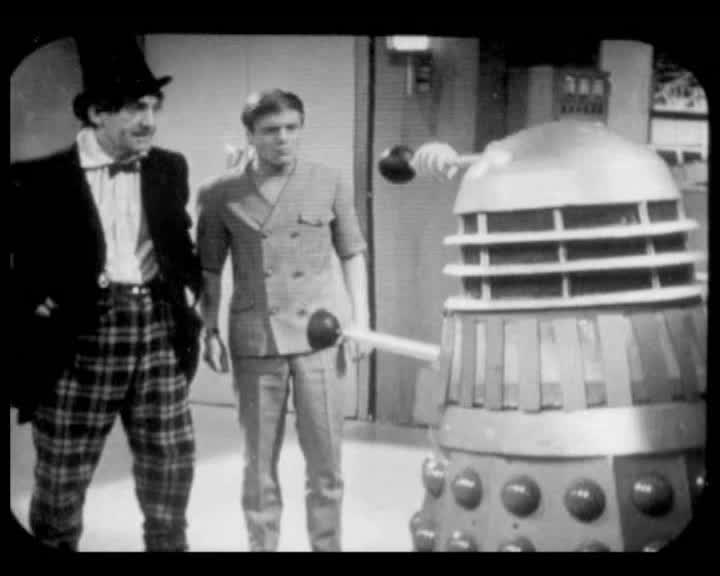
I mean, who else would defeat the Daleks? That's what The Doctor does.

Whitaker (to his credit) included a bunch of different ideas of this new Doctor, chief amongst which was the notion that this wasn't The Doctor's first regeneration (something that would, again, be picked up upon in "The Brain of Morbius"). Head of Drama Sydney Newman (who had helped bring Doctor Who to life) was somewhat dissatisfied by these aspects of Whitaker's script and requested a re-write. Whitaker (having completed his scripts and having moved on to something else) was unavailable, so duties fell to Dennis Spooner, Whitaker's successor as script editor, who trimmed up Whitaker's drafts and tweaked the portrayal of The Doctor to better align with Newman's ideas.

The result is "Power of the Daleks", the first ever regeneration story, the first ever 2nd Doctor story, and the last entry for this blog. And I'll just say this before we start: just like "Androzani" last week, I have been saving this one. And now for the last time...

So let's get to it!

Tuesday, June 26, 2012

Serial 136: The Twin Dilemma

Doctor: Colin Baker (6th Doctor)
Companion: Peri Brown

Written by: Anthony Steven
Directed by: Peter Moffat

Background & Significance: Of all the stories we've thus far reviewed on this blog, none have I been more scared of discussing than "The Twin Dilemma". It's not without reason. In a Doctor Who Magazine Poll in 2009 (in which all the readers ranked every TV story ever), "The Twin Dilemma" came dead last, lower even than "Timelash" and "Time and the Rani" (which, to date are bottom of the barrel, for me anyways). As a slight aside to this, "The Twin Dilemma" is the lowest rated story on this poll, while the story that came before it ("The Caves of Androzani") was ranked the best Doctor Who story of all time. The disparity, to me, is stark. It's weird that what's considered the best Doctor Who story of all time aired finished airing just five days before what is considered the worst.

Me? Yeah. Let's go with "worst".

"The Twin Dilemma" is terribly not good. More than anything (as with, it seems, the entire Colin Baker era) there are a series of huge mistakes and truly, truly bizarre choices that do nothing but hurt not just this serial, but the era.

One of the weird choices that deserves mentioning here, because we probably won't have space to do it later: Airing this story as the final story of Davison's final season, instead of ending it with "Caves of Androzani". The intial idea, of course, was to use this story to tease the viewership with a Doctor and get them excited and talking about that Doctor in the nine month wait for the next series. They had successfully overturned the madness of Tom Baker, and now they would show you where they were going with Colin Baker. Now you'd get excited and get buzzing and talking about it and you'd come back.

That is, of course, assuming that everyone is crazy excited about this new Doctor, which we all know, in retrospect, was not the case at all.

Most tragic, perhaps, is, of course, Colin Baker. We'll talk about it more later, but going into this, I'm going to remind you, again, that Colin Baker WANTED to be The Doctor. He wanted to be awesome. He wanted to outlast Tom Baker. To add to the tragic, he wanted people to come to their love of The Doctor. He wanted to earn it, but the thought was always on his mind. It's when you hear about the fact that he specifically went for extremely elevated diction in an effort to encourage children to expand their vocabulary by looking up the words at home that just... Yeah. That sorta thing just breaks me.

But then... you watch this. And you just... you can read the writing on the wall. You can just... it feels like a joke. Surely this isn't and can't be real. I mean, they made every single wrong decision they could possibly make. They didn't honestly think this would work. Did they?

Hang on. You'll see what I mean. Because I'm not wrong. There's a lot of lessons both in this and that we should come out learning. This is the story that started the epic and tragic fall of the classic run of Doctor Who. And it's heartbreaking to watch.

So let's get to it!

Tuesday, November 8, 2011

Serial 147: Time and The Rani

Doctor: Sylvester McCoy (7th Doctor)
Companion: Mel

Written by: Pip and Jane Baker
Directed by: Andrew Morgan 

Background & Significance: Much like "The Twin Dilemma" and "Timelash", "Time and the Rani" is one of those stories that is almost universally reviled. It always ends up WAY low on those rankings of best Doctor Who stories (and by that I mean, always at the bottom of everything). Granted, the rankings almost always inevitably end up with Tom Baker stories and Dalek stories much higher on the list than, say, Colin Baker stories, but the fact still remains that this is one of those constants that will most likely never change.

It's not really anyone's fault, though. Well, I suppose it is, but it's a miracle it exists at all.

After completing work on the marathon, nightmare of a season that was Trial of a Time Lord, Producer John Nathan-Turner went on a much needed holiday. After all, he was under the assumption that all the nonstop drama from the past few years on Doctor Who (Colin Baker's disastrous tenure (not Mr. Baker's fault) and in-fighting with his script editor (who eventually quit) and people in charge of the BBC who seemed to want nothing more than to cancel Doctor Who) was behind him now. He was moving on! To bigger and brighter pastures. He'd done his time. And now he could do something else.

When he came back from his trip in late December he found that his new assignment was Doctor Who, the show he had just left behind for good. He begged to be taken off the show, but if he left the BBC would cancel it, so he stayed on so that Doctor Who would not die.

But now he was faced with a number of problems. In just over eight months the next season would air. But he didn't have any scripts. He didn't have a new script editor. Hell, he didn't even have a new Doctor. Additionally, any attempts to woo Colin Baker back for a regeneration scene were met by Colin Baker's refusal to reappear after the way he was treated (and if I might commentary a phrase, "Good on ya, Mr. Baker"). Nathan-Turner immediately commissioned Pip and Jane Baker (hereafter referred to as "Pip'n'Jane") for a story, knowing they could write something shootable in a short amount of time, regardless of quality. They decided to bring back their "fan-favourite" creation The Rani. And... well... it turned out so good the first time that why not make her "even better"?

In mid-February Nathan-Turner found his replacement in Sylvester McCoy and had his new Doctor signed to a deal by mid-March. Also around this time, Nathan-Turner found his new script editor: Andrew Cartmel.

Both of these helped put all of the new season of Doctor Who in place, and the new Doctor's first serial commenced shooting in the first week of April, just five weeks after McCoy signed his name on the paperwork that would make him the new Doctor. Bonnie Langford would stay on as Mel (allowing some sort of continuity) and before everyone knew it, the cameras were rolling and the twenty fourth season of Doctor Who was a go, with everyone scrambling about to make it happen.

Needless to say there wasn't a lot of prep time. By the time Cartmel came in to work on the scripts they'd already been commissioned by Nathan-Turner, so he was just cleaning up what would already be established. Similarly, McCoy had barely a month to scramble together a vision and interpretation for his Doctor. The "darkness" and the "chess mastersmanship" would come from Cartmel's influence once the production team had more time to develop the show, which left McCoy to act more comedic and clown-like in this first season of his. It wasn't a perfect solution, but it made for at least something that was vaguely engaging in this first round of stories, and McCoy himself is a very comic actor, which made it a bit easier to play given the complete lack of preparation time to begin with.

The question mark pullover was, of course, Nathan-Turner's idea.

So you can see why this whole thing is leaning towards being something of a sloppy before it even started shooting.

So let's get to it!

Tuesday, March 29, 2011

Serial 116: Castrovalva

Doctor: Peter Davison (5th Doctor)
Companion: Adric, Nyssa, Tegan Jovanka


Written by: Christopher H. Bidmead
Directed by: Fiona Cumming

Background & Significance: It's no secret that I have tons of affection for Peter Davison. I know I mention it every time we talk about one of his stories, but really, I can't help it. The man is a born and bred actor with a real penchant for the character that holds from... minute one, I'd say.

And this is his minute one.

Comparing him to the just-gone-by Tom Baker, the contrast is stark. Again, a Doctor always seems to be a reaction against The Doctor before. Tom Baker's Doctor was... an alien, quick to anger, very... loopy, mismatched in his clothing choices, and... a drunk (haha to that last part). Looking at Davison's Doctor... Davison is decidedly... not.

Davison's Doctor always seems to have a good head on his shoulders, is wonderfully human, always present, rather calm, very dapper... I suspect that, more often than not, people have the propensity to not get him because... he is a challenging Doctor (not, perhaps, as challenging as say Colin Baker, but for that I blame the stories Colin Baker was burdened with). He's much more subtle than all the other Doctors, very much a background player and not a limelight-stealer.

Not only that, but his inception as almost the anti-Tom Baker instantly turns off all the rabid Tom Baker fans who blindly follow him despite many examples of his failures.

Davison's era ushered in a real creative renaissance to Doctor Who. For a show that had been mostly languishing for the several years (and let's be honest, the show was never quite the same after the departure of Hinchcliffe/Holmes), the Doctor Who team (led by Davison, Jonathan Nathan-Turner, and script editor Eric Saward) shot the show full of adrenaline the likes of which the show hadn't seen in years. What had started with the final season of Tom Baker spun off into a new direction under the new Doctor.

"Castrovalva" is where all of that starts, with an adventure I've mostly heard called "slow", "boring", and "underwhelming" for the most part. That's a moot point as the real question is: does it effectively setup this new Doctor for his tenure and his stretch of stories? We've already seen a few post-regeneration stories, all designed to set us up to this new guy we're supposed to love. My question is, as always, does "Castrovalva" work?

So let's get to it!

Tuesday, January 4, 2011

Serial 51: Spearhead from Space

Doctor: Jon Pertwee (3rd Doctor)
Companion: Liz Shaw

Written by: Robert Holmes
Directed by: Derek Martinus

Background & Significance: Because of the way Classic Doctor Who worked as a convention, the way the stories were told and how they were serialized individual stories but without any real overarching serialization or continuity, it's rare for a Doctor Who story to be "important". "Pyramids of Mars" can be all the fantastic in the world. Still doesn't make it "important." Important stories are typically regeneration stories (not even necessarily companion arrivals or departures because they're almost always backgrounded excepting certain instances).

"Spearhead From Space" is one of those stories that is... well... Extremely important.

For one thing, "Spearhead from Space" is the first time in Who history that the Classical-Gallifrey-favourite line "God damn, Robert Holmes" comes into play. Holmes had previously done two Doctor Who stories ("The Krotons" and "The Space Pirates"), both Patrick Troughton stories (to lesser or greater effect), but "Spearhead From Space" is the first one that really mattered in the overall scope of Doctor Who both from a Robert-Holmes-quality standpoint and from a game-changer standpoint (Holmes would later change the game with such stories as "The Ark in Space", "The Deadly Assassin", and "The Caves of Androzani").

"Spearhead from Space" is significant for a number of reasons.

It's the first Jon Pertwee serial. It's the first time Doctor Who was broadcast in colour. It's the first Doctor Who story to be entirely shot on film. It's the first story of The Doctor's five-year exile on Earth, commonly known as "The UNIT years", which was the five year run under producer Barry Letts and script editor Terrance Dicks (despite Letts's noninvolvement here (it was produced by Derrick Sherwin) it really feels like a fairly "typical" Pertwee story) And it's the introduction of one of my personal favourite villains, The Autons (and oh my god what an introduction).

And Autons aside, all of that groundbreaking firsts stuff has nothing to do with Robert Holmes (the story concepts were developed by Producer Derrick Sherwin and Script Editor Terrence Dicks, the-all-shot-on-film bits was because of a labour strike, and the colour broadcast was a BBC mandate). And yet, it's easily one of my favourite Robert Holmes stories ever. It's exquisite science fiction horror, and all of the "mandates" (specifically the introduction of possibly the show's biggest format change of the classic series: that of The Doctor being confined to Earth during the UNIT years) feels like an afterthought amidst the gorgeous distraction of this tremendous story.

So let's get to it!

Tuesday, August 31, 2010

Serial 75: Robot

Doctor: Tom Baker (4th Doctor)
Companion: Sarah Jane Smith, Harry Sullivan

Written by: Terrance Dicks
Directed by: Christopher Barry

Background & Significance: Jon Pertwee left the role of The Doctor after five solid years of stories. Again, he left a void, one to be filled by incoming producer Phillip Hinchcliffe and story editor Robert Holmes.

Hinchcliffe's vision of the show saw a departure from much of his predecessor, Barry Letts, who had relegated The Doctor to UNIT and Earth-based stories for about five years. Hinchcliffe (and his co-brain, Holmes) wanted The Doctor to get back to his pre-exile roots: as a traveling wanderer on the search for the next cool thing to see.

Also wanting to depart from Pertwee's Scientist/Man-of-Action interpretation, Hinchcliffe sought to change his focus on The Doctor, making him a peculiar alien traveler with a silly alien mind that works in silly alien ways. This saw the casting of Tom Baker as The Doctor, kicking off seven long years of Tom Baker stories.

Interestingly enough, Tom Baker's kickoff story is not "Gothic horror" in the way the first three seasons under Hinchcliffe/Holmes are "Gothic". Outgoing script editor Terrance Dicks penned the story (under Robert Holmes's script editing) and - because Doctor Who was filmed in "production blocks", with the last story filmed in a given season's production blog being the first story broadcast for the next season - the story itself still fell under the production purview of Barry Letts before Hinchcliffe's assumption of the role, meaning that what we get is essentially a traditional UNIT story with Tom Baker as The Doctor.

Which is weird.

But we get to see what it's like when Tom Baker picks up his role as The Doctor, bringing as much energy and strength to the role as he ever did, long before he became complacent and began going through the motions (which you can definitely see in the post-Hinchcliffe era when he starts, for lack of better term, phoning it in).

No. Each decision here is specific and well performed and well thought out. And it's damn good Tom Baker. Damn good. Probably my favourite of his so far.

So let's get to it!

Tuesday, May 11, 2010

Doctor Who: The Movie (1996)

Doctor: Paul McGann (8th Doctor)
Companion: Dr. Grace Holloway


Written by: Matthew Jacobs
Directed by: Gregory Sax

Background & Significance: By 1990, Doctor Who was no more. McCoy's tenure ended and the BBC canceled the show. The fanbase, like Trekkies and Browncoats, turned inward to fill the void left by their favorite show. Zines, fanfiction, fan communities, conventions, radio plays... all of "the usual" cropped up to keep the show alive.

Needless to say, after its cancellation, Doctor Who proved itself a viable property, one with amazing staying power. It had all the cultural impact of Star Trek, and if Kirk and Spock et. al. managed to create a giant franchise empire, Doctor Who certainly could as well.

So in the mid '90's, they tried to revive it.

The BBC joined with American studios (attempting to bring in a U.S. viewership) to fund a single, made-for-TV movie with an American broadcaster that would function as a backdoor pilot to an ongoing series. It would be done on the relative cheap and filmed in Vancouver, and if the movie did well enough they would move it to series with this movie serving as the show's first episode.

They also decided that the movie would continue The Doctor's story where it had [essentially] left off in 1989. Certain changes would be enacted as it had to be new-viewer friendly. Other than that, it was essentially the same thing. The movie would introduce key elements. The Time Lords, The Master, Daleks, The TARDIS, and almost all of the original mythology would stay in place. The Doctor would regenerate, making a new incarnation in Paul McGann, giving a new generation a new Doctor to grow to love.

All that? Ridiculously logical. That all makes sense (for the most part). So what could go wrong?

Ohhhhhhhhh so much. As is probably clear, the movie failed to spark any backing or interest in continuing further, specifically from broadcast network Fox. The BBC couldn't move forward without an American network, despite the fact that the movie aired to eight million in Britain (about as large as Doctor Who was back at the end of its run... Which, considering that the show had been off the air for seven years at that point, isn't that bad).

And really, all of the problems everyone has comes from odd choices and lack of good, thrilling story that's--I hate to say worthy, but--worthy of the greatness of Doctor Who.

Personally? I came to this with much excitement. I had been looking forward to Paul McGann since I had first heard about him. And the movie itself didn't sound so awful (some of the complaints from the fanbase are things I was expecting and could just write off or around).

We can discuss all of its failings as we go through it, but just to be clear at the outset: I was excited for Paul McGann going into this, and he did not disappoint. More than anything, he really does a great Doctor. All the problems fall on the story and the writing and the direction and some really strange choices. So let's keep that in mind and separate the movie from The Doctor himself.

So let's get to it!