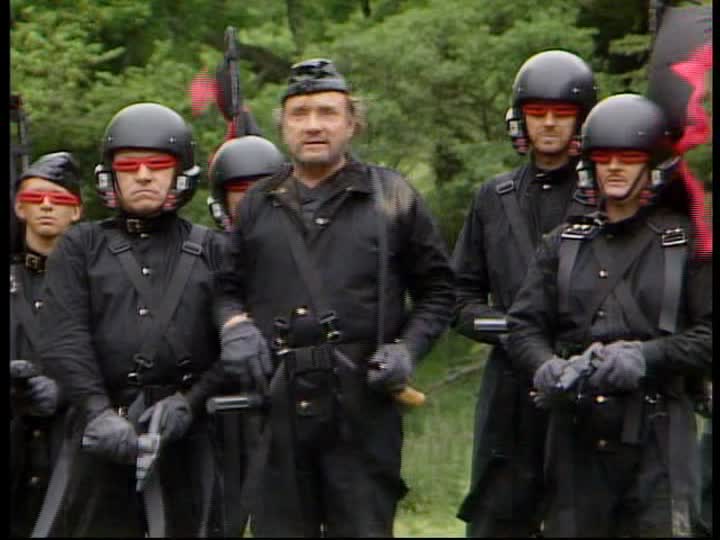
Doctor: Peter Davison (5th Doctor)
Companion: Peri
Written by: Robert Holmes
Directed by: Graeme Harper
Background & Significance: Robert Holmes is one of the three greatest Doctor Who writers of all time,
which is rather fortunate because he also happens to be the most
prolific, writing seventy two of the Classic series' original
almost-seven-hundred episode run (which, by the way, is over ten percent
of all Classic episodes). Throw in the lot that he oversaw as script editor and
that number balloons to one hundred forty four (which is almost 20% of
all Doctor Who episodes ever produced). His run was so
long and prolific, in fact, it can be broken down into stages: two Troughton
era stories (where he got his feet wet), to four classic Pertwee stories
(which allowed him playing ground to experiment with different types of
stories) to his run at script editor when he shaped and created (in a
sense) Tom Baker's Doctor (during which he wrote five stories), to his
few dabbles in the post-him Tom Baker era, to his long break where he
didn't write any Doctor Who stories for five years, to his
triumphant return with "The Caves of Androzani" and his final Colin
Baker stories, which were landmarks and such. In a lot of ways, he
reminds me of The Modern Era's Steven Moffat in that Moffat got his feet
wet during Eccleston, played around with different stories during
Tennant, and then took over the show for a new Doctor when Tennant left.
Both men created/are creating classic, popular foes that are known for
being scary, wrote tremendously famous/popular stories, and they both
are proven to be idea factories through and through.
But "The Caves of Androzani" is his unabashed masterpiece.
We've been talking about Holmes a lot lately. Hell, this is the fourth story penned by Holmes in the past two months, but this is one that's... special. It's the only time Holmes ever wrote for the 5th Doctor and it was his last opportunity to because this is Holmes's opportunity to write a Doctor's regeneration story. Indeed, it really brings him full circle because his bursting onto the scene happened in Jon Pertwee's first story (so he did a post-regen story) after two stories of warm-up. And this is his last story before (essentially) two stories of cool-down (if you count "Trial" as one big monolithic story). It also makes Holmes relatively unique, as he's one of only three other writers (Terrence Dicks, Christopher Bidmead, and Russell T. Davies) to write both a regeneration story (that is, a story that ends in regeneration) and a post-regeneration story (that is, a story that picks up immediately after The Doctor's regeneration).
"Androzani" came about because Eric Saward (having gone back through the Doctor Who archives) became enamored with Holmes and looked for a way to get Holmes back to write a story for Doctor Who again. Somehow Holmes (who apparently thought he'd been away for long enough) and Nathan-Turner (who disliked bringing in people who had been around on the program longer than him and who could thus undermine his authority) both got on board and there was an attempt to get Holmes to write the 20th Anniversary special (what eventually became "The Five Doctors"). Holmes found the laundry list of things to include (Cybermen, a Dalek, Time Lords, Gallifrey, The Master, and Five Doctors) untenable and stepped down from scripting duties. But Saward, not wanting to let go of a good thing and desperate to get Holmes's quality into his own run on the show, managed to persuade Nathan-Turner to bring Holmes in for a different story. That story became, eventually, "The Caves of Androzani", The 5th Doctor's final story.
It's not all about Holmes, though. This story also marks the first behind-the-camera effort for Graeme Harper, who is, for my money, the best Doctor Who director of all time, and this is the first thing he'd ever directed. Ever. He'd been around the show (and other shows) as an assistant at various levels (working under Douglas Camfield at one point). If you know the name, you know for a fact this is not the last thing he directed either and that he went on to do not only "Revelation of the Daleks" but a number of stories during the David Tennant years (including the Cybermen stories in series two, "Utopia" in series three, series four's finale of "Stolen Earth/Journey's End", the exquisite "Waters of Mars", and a bunch of other programs like the BBC's most recent adaptation of Robin Hood.
But this is the first thing he ever directed, so I guess it's worth seeing if he puts his back into it and if there's any hints of a great director in here who might one day blossom into someone fantastic amazing.
I suppose I should also mention that in that Doctor Who Mighty 200 poll this came out at the very very top. So it is considered (at least as of 2009) as the fan-consensus greatest Doctor Who story ever produced. So no pressure there. That poll is basically just saying that this story is better than every single other Doctor Who story we've ever yet talked about. That's a tall order and with fifty years of television stories I'd say... well... it's worth discussing whether or not this is the best Doctor Who story ever. Granted, I know my own thoughts based on the one previous time I've watched this. I'm just wondering if this will confirm or adjust them.
So let's get to it!
Showing posts with label Producer: Jonathan Nathan-Turner. Show all posts
Tuesday, December 18, 2012
Tuesday, November 20, 2012
Serial 140: The Two Doctors
Doctor: Colin Baker (6th Doctor), Patrick Troughton (2nd Doctor)
Companion: Peri Brown, Jamie McCrimmon
Written by: Robert Holmes
Directed by: Peter Moffat
Background & Significance: In 1985 Doctor Who turned twenty two. So it was a few years past the 20th and still a few years from the 25th. Other than that, it's not really that remarkable. Sure, I suppose it's the sole season featuring Colin Baker as The Doctor. Compared to the previous twenty two, his twenty third is positively abbreviated, so it's hard to count that in my head. This was his first proper season. Other than that, there's nothing special or remarkable about it, is there?
And yet here we are talking about a multi-Doctor crossover.
Given the rousing success with which Robert Holmes had written "The Caves of Androzani", Eric Saward was quick to hire him back for another go at some Doctor Who. John Nathan-Turner (capable of knowing how good "Androzani" was and being not unintelligent) was quick to acquiesce to the idea. So we have the return of Robert Holmes offering one of his last stories for one of the most... marmite seasons of Doctor Who ever. And he was given a laundry list of things to do: bring in the 2nd Doctor. And Jamie. And Sontarans. Oh and set it in America. We're thinking New Orleans, because that lines up with your desire to do a story about food.
It was soon changed from Seville from New Orleans because the location filming fell through. And honestly, why not Spain?
But the point stands that this story had a laundry list of things to accomplish and Holmes had three whole episodes (the equivalent of a six parter in the old, 25-minute episode days) with which to incorporate all his ideas. And is it too much? Perhaps? How does Holmes react to the violence and intensity that he helped usher in with "Androzani"? How does he handle all of these elements and how does Colin Baker do? So many thoughts. I mean, well, we haven't talked about C. Baker in a god damn age. And it'll be the last time we talk about him. Sad.
So let's get to it!
Companion: Peri Brown, Jamie McCrimmon
Written by: Robert Holmes
Directed by: Peter Moffat
Background & Significance: In 1985 Doctor Who turned twenty two. So it was a few years past the 20th and still a few years from the 25th. Other than that, it's not really that remarkable. Sure, I suppose it's the sole season featuring Colin Baker as The Doctor. Compared to the previous twenty two, his twenty third is positively abbreviated, so it's hard to count that in my head. This was his first proper season. Other than that, there's nothing special or remarkable about it, is there?
And yet here we are talking about a multi-Doctor crossover.
Given the rousing success with which Robert Holmes had written "The Caves of Androzani", Eric Saward was quick to hire him back for another go at some Doctor Who. John Nathan-Turner (capable of knowing how good "Androzani" was and being not unintelligent) was quick to acquiesce to the idea. So we have the return of Robert Holmes offering one of his last stories for one of the most... marmite seasons of Doctor Who ever. And he was given a laundry list of things to do: bring in the 2nd Doctor. And Jamie. And Sontarans. Oh and set it in America. We're thinking New Orleans, because that lines up with your desire to do a story about food.
It was soon changed from Seville from New Orleans because the location filming fell through. And honestly, why not Spain?
But the point stands that this story had a laundry list of things to accomplish and Holmes had three whole episodes (the equivalent of a six parter in the old, 25-minute episode days) with which to incorporate all his ideas. And is it too much? Perhaps? How does Holmes react to the violence and intensity that he helped usher in with "Androzani"? How does he handle all of these elements and how does Colin Baker do? So many thoughts. I mean, well, we haven't talked about C. Baker in a god damn age. And it'll be the last time we talk about him. Sad.
So let's get to it!
Tuesday, November 13, 2012
Serial 157: The Curse of Fenric
Companion: Ace
Written by: Ian Briggs
Directed by: Nicholas Mallett
Background & Significance: With the rise of Nu-Who, one of the questions that comes around regularly is "Where do I start with the Classic Series". There's a few different answers. Perhaps the most popular is to watch "An Unearthly Child" and then go for there. The other answer I hear a lot is to warm people to the show through the Hinchcliffe/Holmes era and see how they like it. The idea here is to ease them into the production values with kickass stories that will make them not care. Then introduce them to other stories.
Me? I did something slightly different.
The other big recommendation is instead of going for more-than-adequate production values, you could always start with the eight 7th/Ace stories. They are the most "modern" in terms of dealing with The Doctor AND his companion as real characters with wants, needs, desires, etc. Ace herself is given an emotional and psychological clarity not afforded to previous companions, and comparing her to a previous companion like Tegan or Sarah Jane it's easy to see. Ace is impossibly specific in her construction and the role she fills in Doctor Who stories, enough so that you can tell that the Nu-Who companions like Rose, Martha, Donna, Amy, etc. were all spun out of the cloth that Ace started with. It's not perfectly there and there's a way to go before then but it's mostly on the page for the 7th Doctor stories, and thusly provides a good entry point.
Which brings us to "The Curse of Fenric".
"The Curse of Fenric" is the twilight of Doctor Who's original twenty six year run and it's something of a doozy. Next to "Remembrance" is considered the best of its era, which is no small feat and if there's one story that's unequivocally about Ace, it's absolutely this one. And why wouldn't it be? Written by Ian "Dragonfire" Briggs, it's a story that delves into Ace's past and pushes both her and The Doctor to a brink, leading to something so immensely iconic that they basically ripped it off and shoved it into "The God Complex" to give that its awesome ending.
And if it's good enough for Nu-Who...
So let's get to it!
Friday, September 28, 2012
Serial 127: Enlightenment - The Black Guardian Trilogy Part III
Companion: Tegan, Turlough
Written by: Barbara Clegg
Directed by: Fiona Cumming
Background & Significance: With "Terminus" in the rearview mirror, the Doctor Who production team set about looking for a story that would wrap up this "Black Guardian Trilogy" that was the centerpiece of season twenty. To write it, Eric Saward brought in Barbara Clegg, whom he knew from his time working in radio. To direct, Nathan-Turner brought back returning stalwart Fiona Cumming, who had just come off directing the phenomenal "Snakedance".
What's remarkable is that Nathan-Turner even managed to produce it. The story itself ran afoul of a labour strike (don't they always) and Nathan-Turner sacrificed what eventually became "Resurrection of the Daleks" to make it happen. Clearly this pained Nathan-Turner, who was a big proponent for The Daleks returning because, hey, ratings! But that sacrifice led to one of the true high points of the era and one of the best Classic stories, as far as I'm concerned. It's a personal favourite of mine, and as we round the corner towards the last three months of this blog, I love that I'm finally able to talk about it.
So let's get to it!
Wednesday, September 26, 2012
Serial 126: Terminus - The Black Guardian Trilogy Part II
Doctor: Peter Davison (5th Doctor)Companion: Nyssa, Tegan Jovanka, Vislor Turlough
Written by: Stephen Gallagher
Directed by: Mary Ridge
Editor's Note: 'allo, chaps! Matt here stepping in to intro Cassandra's discussion of "Terminus". It's a mid-week thing because we're in the middle of a linked story (the things we do!) but I will be back in a few days to discuss the fantastic "Enlightenment" so stay tuned for that. Also, appreciate the Cassandra because she's only got one more to go. Lucky her!
Background & Significance: "Terminus" is the second in a loose trilogy of stories featuring the introduction of new companion Turlough and the return of the Black Guardian from Key to Time. As fate would had it, this story also served as a departure for Nyssa, who was supposed to fall ill and leave in the previous season, but managed to hold on til this story when JNT decided she'd truly run her course.Granted, for all he brought to the show, I don't really agree with all of his decisions in a producer capacity, and this is one of them. I personally love Nyssa, but she was never given the chance to grow as a character ever. This really hurts her departure, because it pretty much comes out of nowhere (as we'll see); and even Davison himself was against the decision, believing Nyssa to be the best and most compatible companion for his Doctor (and he is not wrong).
Written by Steven "Warrior's Gate" Gallagher, you'd think this would be a much better outing with such a story under his belt. I mean, he's already written a "suitable" companion departure for Romana, and "Warrior's Gate" was interesting and fairly cerebral, which I like in a Doctor Who story. Unfortunately, I don't feel he lives up to the promise with this.
"Terminus" is the only Doctor Who story directed by Mary Ridge, who had a long-standing relationship with the BBC, but her stint as director for this story was so fraught with trouble and rushed (and it really shows), it ultimately resulted in a really icy and uncomfortable relationship/falling out with JNT, so she never returned. Which is a shame, because there is some really good stuff buried in here, but...
Anyway, enough of all that. Let's take a closer look, shall we?
Monday, September 24, 2012
Serial 125: Mawdryn Undead - The Black Guardian Trilogy Part I
Doctor: Peter Davison (5th Doctor)
Companion: Nyssa, Tegan, Turlough
Written by: Peter Grimwade
Directed by: Peter Moffat
Background & Significance: For Doctor Who's twentieth season, producer Jonathan Nathan-Turner had the idea to bring back a bunch of The Doctor's old villains in an effort to tie every story to the legacy of the show. The kick off story ("Arc of Infinity") featured the return of the "anniversary villain" Omega and the next story ("Snakedance") featured the return of the previous season's "Mara". There were plans for The Master to return ("The King's Demons") and plans were made for the Daleks' return at the end of the season in "The Return" (which fell through and became "Resurrection of the Daleks").
But the middle of the season featured a trilogy of stories that featured The Black Guardian as something of a background running villain. It allowed the story to do new and interesting things with new and exciting villains while still retaining the "returning villain" mandate.
This is widely referred to as "The Black Guardian Trilogy". Indeed, it's even boxed and sold that way on DVD as a trilogy of 5th stories. And yet, that's not quite accurate. See, the Black Guardian (as we find out here) is just a means to an end to finish replacing Adric. It's here that we get the introduction of a new companion: Turlough. As originally conceived, Turlough was somewhat duplicitous and (for lack of better phrase) "The Evil Companion". As an idea, this was one that captured the imagination of script editor Eric Saward, who was always looking at new ways to shake things up. They would roll out this character over the course of this "Black Guardian Trilogy" and once it was all said and done they could decide whether or not they wanted to keep him around as a permanent companion.
So what I'm saying is this trilogy should be called "Vislor Turlough, or How I Learned To Stop Hating The Doctor and Join The TARDIS crew".
Written by Peter Grimwade, who was trying his hand again at writing after the disaster of "Time-Flight", focusing away from directing after having a run of phenomenal stories. Fortunately, this time around he's much more successful. It's also the return of Peter Moffat to the directing chair. But perhaps most importantly, it's the return of Nicholas Courtney as The Brigadier. Ironically, last week we talked about him in his last appearance til this one, so much like The Brigadier here, we're jumping from one story to the next with no cover over inbetween. Granted, it was SUPPOSED to be William Russell as Ian Chesterton, but he wasn't available. Nor was Ian Marter (Harry), Nathan-Turner's second choice. Which left Nick Courtney to return.
And oh what a wonderful bendy return it is.
So let's get to it!
Companion: Nyssa, Tegan, Turlough
Written by: Peter Grimwade
Directed by: Peter Moffat
Background & Significance: For Doctor Who's twentieth season, producer Jonathan Nathan-Turner had the idea to bring back a bunch of The Doctor's old villains in an effort to tie every story to the legacy of the show. The kick off story ("Arc of Infinity") featured the return of the "anniversary villain" Omega and the next story ("Snakedance") featured the return of the previous season's "Mara". There were plans for The Master to return ("The King's Demons") and plans were made for the Daleks' return at the end of the season in "The Return" (which fell through and became "Resurrection of the Daleks").
But the middle of the season featured a trilogy of stories that featured The Black Guardian as something of a background running villain. It allowed the story to do new and interesting things with new and exciting villains while still retaining the "returning villain" mandate.
This is widely referred to as "The Black Guardian Trilogy". Indeed, it's even boxed and sold that way on DVD as a trilogy of 5th stories. And yet, that's not quite accurate. See, the Black Guardian (as we find out here) is just a means to an end to finish replacing Adric. It's here that we get the introduction of a new companion: Turlough. As originally conceived, Turlough was somewhat duplicitous and (for lack of better phrase) "The Evil Companion". As an idea, this was one that captured the imagination of script editor Eric Saward, who was always looking at new ways to shake things up. They would roll out this character over the course of this "Black Guardian Trilogy" and once it was all said and done they could decide whether or not they wanted to keep him around as a permanent companion.
So what I'm saying is this trilogy should be called "Vislor Turlough, or How I Learned To Stop Hating The Doctor and Join The TARDIS crew".
Written by Peter Grimwade, who was trying his hand again at writing after the disaster of "Time-Flight", focusing away from directing after having a run of phenomenal stories. Fortunately, this time around he's much more successful. It's also the return of Peter Moffat to the directing chair. But perhaps most importantly, it's the return of Nicholas Courtney as The Brigadier. Ironically, last week we talked about him in his last appearance til this one, so much like The Brigadier here, we're jumping from one story to the next with no cover over inbetween. Granted, it was SUPPOSED to be William Russell as Ian Chesterton, but he wasn't available. Nor was Ian Marter (Harry), Nathan-Turner's second choice. Which left Nick Courtney to return.
And oh what a wonderful bendy return it is.
So let's get to it!
Tuesday, September 11, 2012
Serial 149: Delta and the Bannermen
Companions: Ace, Mel
Written by: Malcolm Kohll
Directed by: Chris Clough
Background & Significance: As the first season of Sylvester McCoy was in full swing, a number of changes swept across the behind-the-scenes production of Doctor Who. First, John Nathan-Turner needed to rectify the fact that he had an "uneven" number of episodes to spread across and indeterminate amount of stories. There was the option to do a six parter, but that wasn't particularly attractive. The last time he had tried something that length it had cobbled the story before it had even begun and a four part story and a two part story felt like it was giving short shrift to the two part story. To compromise, they devised the notion of coming up with two three-part stories, one shot on location (in this season, "Delta and the Bannermen") and the other shot entirely in the studio (in this season, "Dragonfire").
Oh. And Bonnie Langford wanted to leave. So The Doctor was gonna need a new companion. And fast.
This left the show with a noticeable hole they needed to fill. The continuity Langford brought to the show as it transitioned from Baker to McCoy cannot possibly be overstated, but now the 7th Doctor was going to need to move on and with his own companion. Cartmel, as script editor, set about devising a new companion almost immediately, sketching out the broad designs for a hip teenagery character who'd be more... shall we say "realistic" than the companions as of late. Peri was something of a socialite when it came down to it and Mel was never actually given a proper introduction story NOR was her history ever intimated as anything other than a bubblegum-chewing, aerobics-obsessed, bright, bubbly teenager. Cartmel wanted something different, something that would be a bit more realistic to the world of the 80s. Someone that wouldn't be focused so much on the jazzercise as the more punk and anti-establishment leanings that were present at the time.
So he came up with this character (whom he dubbed "Alf") with plans to introduce her after Mel's departure, but he also asked that the two scripts that were meant to cap the season ("Delta" and the previously discussed "Dragonfire") introduce a version of his "Alf" character, hoping that they would come up with something good that they could use instead of having to come up with a character on the fly later on. And applause to the delgation of that. I mean, even Robert Holmes did something similar when it came to Leela's introduction (handing off the responsibility to Chris Boucher). As we all know Ian Briggs's "Dragonfire" ended up giving us Ace while Malcolm Kohll's script ended up giving us a character known as "Ray" about whom I'll have much to say later.
Why Ray didn't work and was never mentioned again will certainly be point of discussion for this entry.
Kohll, it's worth mentioning, was not really ever brought back to write more Doctor Who. Cartmel, it seems, did have him in mind moving forward, but where Stephen "Paradise Towers" Wyatt and Ian "Dragonfire" Briggs were both brought back for "Greatest Show in the Galaxy" and "Curse of Fenric" respectively, it's interesting that Kohll never made it back for another story. Director Chris Clough, on the other hand, was invited back for another round of stories in the next season. Take that for what that's worth.
So let's get to it!
Oh. And Bonnie Langford wanted to leave. So The Doctor was gonna need a new companion. And fast.
This left the show with a noticeable hole they needed to fill. The continuity Langford brought to the show as it transitioned from Baker to McCoy cannot possibly be overstated, but now the 7th Doctor was going to need to move on and with his own companion. Cartmel, as script editor, set about devising a new companion almost immediately, sketching out the broad designs for a hip teenagery character who'd be more... shall we say "realistic" than the companions as of late. Peri was something of a socialite when it came down to it and Mel was never actually given a proper introduction story NOR was her history ever intimated as anything other than a bubblegum-chewing, aerobics-obsessed, bright, bubbly teenager. Cartmel wanted something different, something that would be a bit more realistic to the world of the 80s. Someone that wouldn't be focused so much on the jazzercise as the more punk and anti-establishment leanings that were present at the time.
So he came up with this character (whom he dubbed "Alf") with plans to introduce her after Mel's departure, but he also asked that the two scripts that were meant to cap the season ("Delta" and the previously discussed "Dragonfire") introduce a version of his "Alf" character, hoping that they would come up with something good that they could use instead of having to come up with a character on the fly later on. And applause to the delgation of that. I mean, even Robert Holmes did something similar when it came to Leela's introduction (handing off the responsibility to Chris Boucher). As we all know Ian Briggs's "Dragonfire" ended up giving us Ace while Malcolm Kohll's script ended up giving us a character known as "Ray" about whom I'll have much to say later.
Why Ray didn't work and was never mentioned again will certainly be point of discussion for this entry.
Kohll, it's worth mentioning, was not really ever brought back to write more Doctor Who. Cartmel, it seems, did have him in mind moving forward, but where Stephen "Paradise Towers" Wyatt and Ian "Dragonfire" Briggs were both brought back for "Greatest Show in the Galaxy" and "Curse of Fenric" respectively, it's interesting that Kohll never made it back for another story. Director Chris Clough, on the other hand, was invited back for another round of stories in the next season. Take that for what that's worth.
So let's get to it!
Tuesday, August 7, 2012
Serial 150: Dragonfire
Doctor: Sylvester McCoy (7th Doctor)
Companions: Mel, Ace
Written by: Ian Briggs
Directed by: Chris Clough
Background & Significance: After a whole season of Mel as The Doctor's companion, Bonnie Langford had decided that she did not want to be Mel anymore. She feared typecasting (which, as it turns out, was an entirely founded claim) and wanted to move on. It probably didn't help that Mel is [unfairly] hated by vast majorities of Doctor Who fandom despite Langford being actually quite good. She just happened to be in the wrong place at the wrong time and was never really given a fair shake until Big Finish went in and proved to everyone how utterly brilliant she could be.
So the decks were clear for a new companion.
To prep, Nathan-Turner and script editor Andrew Cartmel started the process off creating a new companion, sketching out a few ideas and characteristics they thought would be good for a new companion. Affectionately code-named "Alf", they planned for this character to take over as The Doctor's companion in the upcoming season should Bonnie Langford choose to actually depart as she was thinking. To see if their other writers could come up with anything better, they handed the rough sketch to "Delta and the Bannermen's" Malcolm Kohll and "Dragonfire's" Ian Briggs to see if they could do anything with the concept. (This, by the way, explains why Ray in "Delta and the Bannermen" is a totally Ace-y character, but we'll talk about that in a few weeks.)
History, as we know, went with Ian Briggs's character: Ace.
Let's back up, though. Ian Briggs was a fresh new Doctor Who writer whose mission statement was to make something with a comedic bent. In response, he went and basically homaged all of his favorite movies, and when one homage didn't work out he simply went and changed the source of the homage. This, unfortunately, was mostly lost on the audience of "Dragonfire", who can't ever seem to see beyond the "that cliffhanger moment is stupid" and see that the whole thing as a big ol' Star Wars homage pulp adventure running through a bunch of ice-flavored BBC sets. While being camp. Utter utter camp. So like last week we have a story that is utterly and completely derided story that wound up in the bottom 10% of the Doctor Who Magazine Top 200 poll. And I really have to ask, is the hate deserved?
So let's get to it!
Companions: Mel, Ace
Written by: Ian Briggs
Directed by: Chris Clough
Background & Significance: After a whole season of Mel as The Doctor's companion, Bonnie Langford had decided that she did not want to be Mel anymore. She feared typecasting (which, as it turns out, was an entirely founded claim) and wanted to move on. It probably didn't help that Mel is [unfairly] hated by vast majorities of Doctor Who fandom despite Langford being actually quite good. She just happened to be in the wrong place at the wrong time and was never really given a fair shake until Big Finish went in and proved to everyone how utterly brilliant she could be.
So the decks were clear for a new companion.
To prep, Nathan-Turner and script editor Andrew Cartmel started the process off creating a new companion, sketching out a few ideas and characteristics they thought would be good for a new companion. Affectionately code-named "Alf", they planned for this character to take over as The Doctor's companion in the upcoming season should Bonnie Langford choose to actually depart as she was thinking. To see if their other writers could come up with anything better, they handed the rough sketch to "Delta and the Bannermen's" Malcolm Kohll and "Dragonfire's" Ian Briggs to see if they could do anything with the concept. (This, by the way, explains why Ray in "Delta and the Bannermen" is a totally Ace-y character, but we'll talk about that in a few weeks.)
History, as we know, went with Ian Briggs's character: Ace.
Let's back up, though. Ian Briggs was a fresh new Doctor Who writer whose mission statement was to make something with a comedic bent. In response, he went and basically homaged all of his favorite movies, and when one homage didn't work out he simply went and changed the source of the homage. This, unfortunately, was mostly lost on the audience of "Dragonfire", who can't ever seem to see beyond the "that cliffhanger moment is stupid" and see that the whole thing as a big ol' Star Wars homage pulp adventure running through a bunch of ice-flavored BBC sets. While being camp. Utter utter camp. So like last week we have a story that is utterly and completely derided story that wound up in the bottom 10% of the Doctor Who Magazine Top 200 poll. And I really have to ask, is the hate deserved?
So let's get to it!
Tuesday, June 26, 2012
Serial 136: The Twin Dilemma
Doctor: Colin Baker (6th Doctor)
Companion: Peri Brown
Written by: Anthony Steven
Directed by: Peter Moffat
Background & Significance: Of all the stories we've thus far reviewed on this blog, none have I been more scared of discussing than "The Twin Dilemma". It's not without reason. In a Doctor Who Magazine Poll in 2009 (in which all the readers ranked every TV story ever), "The Twin Dilemma" came dead last, lower even than "Timelash" and "Time and the Rani" (which, to date are bottom of the barrel, for me anyways). As a slight aside to this, "The Twin Dilemma" is the lowest rated story on this poll, while the story that came before it ("The Caves of Androzani") was ranked the best Doctor Who story of all time. The disparity, to me, is stark. It's weird that what's considered the best Doctor Who story of all time aired finished airing just five days before what is considered the worst.
Me? Yeah. Let's go with "worst".
"The Twin Dilemma" is terribly not good. More than anything (as with, it seems, the entire Colin Baker era) there are a series of huge mistakes and truly, truly bizarre choices that do nothing but hurt not just this serial, but the era.
One of the weird choices that deserves mentioning here, because we probably won't have space to do it later: Airing this story as the final story of Davison's final season, instead of ending it with "Caves of Androzani". The intial idea, of course, was to use this story to tease the viewership with a Doctor and get them excited and talking about that Doctor in the nine month wait for the next series. They had successfully overturned the madness of Tom Baker, and now they would show you where they were going with Colin Baker. Now you'd get excited and get buzzing and talking about it and you'd come back.
That is, of course, assuming that everyone is crazy excited about this new Doctor, which we all know, in retrospect, was not the case at all.
Most tragic, perhaps, is, of course, Colin Baker. We'll talk about it more later, but going into this, I'm going to remind you, again, that Colin Baker WANTED to be The Doctor. He wanted to be awesome. He wanted to outlast Tom Baker. To add to the tragic, he wanted people to come to their love of The Doctor. He wanted to earn it, but the thought was always on his mind. It's when you hear about the fact that he specifically went for extremely elevated diction in an effort to encourage children to expand their vocabulary by looking up the words at home that just... Yeah. That sorta thing just breaks me.
But then... you watch this. And you just... you can read the writing on the wall. You can just... it feels like a joke. Surely this isn't and can't be real. I mean, they made every single wrong decision they could possibly make. They didn't honestly think this would work. Did they?
Hang on. You'll see what I mean. Because I'm not wrong. There's a lot of lessons both in this and that we should come out learning. This is the story that started the epic and tragic fall of the classic run of Doctor Who. And it's heartbreaking to watch.
So let's get to it!
Companion: Peri Brown
Written by: Anthony Steven
Directed by: Peter Moffat
Background & Significance: Of all the stories we've thus far reviewed on this blog, none have I been more scared of discussing than "The Twin Dilemma". It's not without reason. In a Doctor Who Magazine Poll in 2009 (in which all the readers ranked every TV story ever), "The Twin Dilemma" came dead last, lower even than "Timelash" and "Time and the Rani" (which, to date are bottom of the barrel, for me anyways). As a slight aside to this, "The Twin Dilemma" is the lowest rated story on this poll, while the story that came before it ("The Caves of Androzani") was ranked the best Doctor Who story of all time. The disparity, to me, is stark. It's weird that what's considered the best Doctor Who story of all time aired finished airing just five days before what is considered the worst.
Me? Yeah. Let's go with "worst".
"The Twin Dilemma" is terribly not good. More than anything (as with, it seems, the entire Colin Baker era) there are a series of huge mistakes and truly, truly bizarre choices that do nothing but hurt not just this serial, but the era.
One of the weird choices that deserves mentioning here, because we probably won't have space to do it later: Airing this story as the final story of Davison's final season, instead of ending it with "Caves of Androzani". The intial idea, of course, was to use this story to tease the viewership with a Doctor and get them excited and talking about that Doctor in the nine month wait for the next series. They had successfully overturned the madness of Tom Baker, and now they would show you where they were going with Colin Baker. Now you'd get excited and get buzzing and talking about it and you'd come back.
That is, of course, assuming that everyone is crazy excited about this new Doctor, which we all know, in retrospect, was not the case at all.
Most tragic, perhaps, is, of course, Colin Baker. We'll talk about it more later, but going into this, I'm going to remind you, again, that Colin Baker WANTED to be The Doctor. He wanted to be awesome. He wanted to outlast Tom Baker. To add to the tragic, he wanted people to come to their love of The Doctor. He wanted to earn it, but the thought was always on his mind. It's when you hear about the fact that he specifically went for extremely elevated diction in an effort to encourage children to expand their vocabulary by looking up the words at home that just... Yeah. That sorta thing just breaks me.
But then... you watch this. And you just... you can read the writing on the wall. You can just... it feels like a joke. Surely this isn't and can't be real. I mean, they made every single wrong decision they could possibly make. They didn't honestly think this would work. Did they?
Hang on. You'll see what I mean. Because I'm not wrong. There's a lot of lessons both in this and that we should come out learning. This is the story that started the epic and tragic fall of the classic run of Doctor Who. And it's heartbreaking to watch.
So let's get to it!
Tuesday, May 29, 2012
Serial 132: Frontios
Doctor: Peter Davison (5th Doctor)
Companions: Tegan, Turlough
Written by: Christopher H. Bidmead
Directed by: Ron Jones
Background & Significance: "Frontios" is the last great hurrah of the Peter Davison era before it starts slowly transitioning away from it and writing out all of the major characters in anticipation for Colin Baker. This is the last story of the season that isn't based on a main character's departure or introduction and (for some reason, quite fittingly) it brings the TARDIS crew to the very edge of civilization itself.
It's interesting, then, that this story is written by Christopher H. Bidmead, a lovely fellow who oversaw both the end of Tom Baker and the beginning of Peter Davison right before the four-story upheaval that serves as the crux of the back half of season twenty-one. As an on-again, off-again fan of Bidmead's, it's an interesting case-study, especially as it's the Davison story I saved for last when I was popcorn-watching all the way through the show. It's quite different, but I'm not convinced this is a bad thing. I do think Bidmead does some really good work. It's sometimes incredibly difficult to put together, but I do find myself enjoying his stories quite a bit when all is said and done. So really, this could go either way.
And then we have Ron Jones, who for those who don't remember, is one of those Doctor Who directors who seems to direct turkeys. I don't mind "Black Orchid", but "Time-Flight" and "Arc of Infinity" are rubbish and I positively can't stand "Vengeance on Varos" no matter what anyone says to me.
In summation, it's the last hurrah of the script editor who came before Saward, a middle story for an extremely middling-to-awful director, and the last story of the 5th Doctor/Tegan/Turlough combination in which they all remain intact as a team when the story's all said and done. To add to the madness, we have big 'ol monsters and the TARDIS at the very edge of where it can travel. In other words, it's one giant roll of the dice.
So let's get to it!
Tuesday, May 8, 2012
Serial 148: Paradise Towers
Doctor: Sylvester McCoy (7th Doctor)
Companion: Mel
Written by: Stephen Wyatt
Directed by: Nicholas Mallett
Background & Significance: As we said back when we reviewed "Time and the Rani", it's hard to blame McCoy's first season on anyone. It's really more a case of rushed and slapped together delivery. Nathan-Turner wasn't expecting to produce another season of Doctor Who (let alone two more after it), nor did Cartmel have a lot of time to develop a tone or direction going in.
The best way to judge the season is by judging the things that came on either side of it. Take "Time and the Rani". The Bakers were notoriously mediocre writers (that's putting it mildly) so it's no wonder that story mostly sucked beyond all belief. Andrew Morgan really knocked "Remembrance" out of the park, so he's really just saddled with a bad script and a rushed production, neither of which he can do much with. So too, with "Paradise Towers" we have a writer and director who have great credits on either side of this story. Mallett really did a great job with "The Mysterious Planet" if you ask me, and I quite enjoy the direction on "Fenric", and were it not for "Remembrance", Wyatt's other Doctor Who script ("The Greatest Show in the Galaxy") would easily be the best of its season.
For one thing, it's the return of yet another Doctor Who staple: an anti-establishment Doctor bringing down the government he's landed in and tearing down the infrastructures of society so that it can be remade. The difference here is that it's got Mel (whom fandom had already decided they hated; still do by and large, actually) and it's blatantly on the nose about the fact that it's about fascism and the perils and horror therein. It also suffers from the Cartmel direction and while you can see the hints of it starting to poke out, it's still not crystalized so efficiently as it is in McCoy's two subsequent seasons.
So it's maligned and perhaps unfairly. What do I think? I think I should start talking.
So let's get to it!
Tuesday, April 3, 2012
Serial 124: Snakedance
Companions: Nyssa, Tegan
Written by: Christopher Bailey
Directed by: Fiona Cumming
Editor's Note: Hey, kids! Matt here! Not stepping in this week because I promised Cassandra a good story and because I had already decided I would be fine with "just" doing "Kinda" I [foolishly] promised her "Snakedance" before I had seen it. So she's in this week and I'm left angsting that I don't get to write it. Ah well. It was nice to watch it again (which I just finished doing. TMI?) and while I'm sad I don't get to tackle this story in a blog capacity, I have no doubt that Cassandra will do a bang up job because it's a rich, kick ass story with tons and tons of things to talk about. And hopefully it won't be in the vein of the epics we've been doing around these parts lately. God knows we don't need another "Kinda"-length entry any time soon. Last week's was long enough.
But I'm talking. I do that sometimes. Shutting up now and turning it over to Cassandra for her thoughts on the return of Christopher Bailey and Fiona Cumming.
Background & Significance: There's something about sequels in Doctor Who.
Because television tends to be more serialized than movies, it's interesting whenever a TV show chooses to do a sequel, especially considering the more moder and character arc-centric approach inherent to its storytelling foundations. But with Doctor Who sequels, I tend to be pretty wary of them, because they're usually pretty rubbish. I mean, look at "Monster of Peladon". Same writer, same director, same Doctor, same production team, different Companion, and somehow it managed to take a completely awesome story in "Curse of Peladon" and come up with... well, a crap sequel.
So when I heard that there was a sequel to "Kinda," I wasn't entirely sure what to think. And then we watched it.
And it was awesome.
"Snakedance" is significant because it is a sequel. It was broadcast during Season 20, the 20th anniversary year of Doctor Who. JNT and Saward wanted the year to be epic, so each story in the season was designed to bring back an old adversary of the Doctor. Of course, the Mara sort of sticks out like a sore thumb because it was just introduced in the previous season. But I think that's why it's better than just about every other story in the season. That, and Christopher Bailey is a boss at writing awesome things.
It's also pretty significant because of its cast, which is expertly wrangled together by director Fiona Cumming. Brian Miller, husband of Elisabeth Sladen, is in this story in the role of Dugdale, which is pretty awesome. And it's the first television role of Martin Clunes (Lon), who is a prominent and award-winning actor in the UK, which I guess is kind of a big deal.
But enough of all that. Let's take a closer look, shall we?
Because television tends to be more serialized than movies, it's interesting whenever a TV show chooses to do a sequel, especially considering the more moder and character arc-centric approach inherent to its storytelling foundations. But with Doctor Who sequels, I tend to be pretty wary of them, because they're usually pretty rubbish. I mean, look at "Monster of Peladon". Same writer, same director, same Doctor, same production team, different Companion, and somehow it managed to take a completely awesome story in "Curse of Peladon" and come up with... well, a crap sequel.
So when I heard that there was a sequel to "Kinda," I wasn't entirely sure what to think. And then we watched it.And it was awesome.
"Snakedance" is significant because it is a sequel. It was broadcast during Season 20, the 20th anniversary year of Doctor Who. JNT and Saward wanted the year to be epic, so each story in the season was designed to bring back an old adversary of the Doctor. Of course, the Mara sort of sticks out like a sore thumb because it was just introduced in the previous season. But I think that's why it's better than just about every other story in the season. That, and Christopher Bailey is a boss at writing awesome things.
It's also pretty significant because of its cast, which is expertly wrangled together by director Fiona Cumming. Brian Miller, husband of Elisabeth Sladen, is in this story in the role of Dugdale, which is pretty awesome. And it's the first television role of Martin Clunes (Lon), who is a prominent and award-winning actor in the UK, which I guess is kind of a big deal.
But enough of all that. Let's take a closer look, shall we?
Tuesday, March 20, 2012
Serial 142: Revelation of the Daleks
Doctor: Colin Baker (6th Doctor)
Companion: Peri Brown
Written by: Eric Saward
Directed by: Graeme Harper
Background & Significance: In a lot of ways, "Revelation of the Daleks" represents the end to a number of eras in Doctor Who. Coming at the end of Colin Baker's initial season (which is problematic, to say the very least), this story really signified an ending to the first twenty two years of Doctor Who. From here on out, Doctor Who would be on borrowed time, always under the threat of cancellation. Always with a far abbreviated season than what it was typically used to.
It's also the end culmination of four years of Eric Saward as script editor. How fitting, then, that he should be the fellow to write it.
Because the Daleks always elevated the show's ratings, Producer John Nathan-Turner sought to bring them back for another season after their success in the previous one. Despite the fact that script editors weren't allowed to commission themselves to write for their own show, Saward somehow managed to wriggle his way around the legal workings of this by writing the scripts in the six weeks leading up to the renewal of his contract as script editor for the next round of Doctor Who. It's underhanded, sure. But he wanted to write The Daleks and Davros, and he'd be damned if he'd let any other "unexperienced" writers go out and write them in his stead.
To direct, the production team brought back the excellent Graeme Harper to handle the proceedings. So that's a plus.
But really, it's just the end result of the show's direction over the course of the previous four years. It effectively kills Colin Baker as The Doctor and is his last proper televisual adventure ("Trial" is a more complicated animal and not exactly the most proper of adventures where every "week" he's somewhere new) and is the last time location shooting for the show was shot on film. Location shooting in the future would all be shot on video tape. It's also the last script written by Eric Saward and is very... Sawardian in all its proper respects. As I'm so wont to say, Doctor Who writers only ever seem to get more themier (Moffat only seems to get Moffatier just as Davies only ever seemed to get more Daviesier) and "Revelation" proves itself to be the Sawardiest script of all the scripts he ever wrote for the show.
Wonder how that'll turn out.
So let's get to it!
Companion: Peri Brown
Written by: Eric Saward
Directed by: Graeme Harper
Background & Significance: In a lot of ways, "Revelation of the Daleks" represents the end to a number of eras in Doctor Who. Coming at the end of Colin Baker's initial season (which is problematic, to say the very least), this story really signified an ending to the first twenty two years of Doctor Who. From here on out, Doctor Who would be on borrowed time, always under the threat of cancellation. Always with a far abbreviated season than what it was typically used to.
It's also the end culmination of four years of Eric Saward as script editor. How fitting, then, that he should be the fellow to write it.
Because the Daleks always elevated the show's ratings, Producer John Nathan-Turner sought to bring them back for another season after their success in the previous one. Despite the fact that script editors weren't allowed to commission themselves to write for their own show, Saward somehow managed to wriggle his way around the legal workings of this by writing the scripts in the six weeks leading up to the renewal of his contract as script editor for the next round of Doctor Who. It's underhanded, sure. But he wanted to write The Daleks and Davros, and he'd be damned if he'd let any other "unexperienced" writers go out and write them in his stead.
To direct, the production team brought back the excellent Graeme Harper to handle the proceedings. So that's a plus.
But really, it's just the end result of the show's direction over the course of the previous four years. It effectively kills Colin Baker as The Doctor and is his last proper televisual adventure ("Trial" is a more complicated animal and not exactly the most proper of adventures where every "week" he's somewhere new) and is the last time location shooting for the show was shot on film. Location shooting in the future would all be shot on video tape. It's also the last script written by Eric Saward and is very... Sawardian in all its proper respects. As I'm so wont to say, Doctor Who writers only ever seem to get more themier (Moffat only seems to get Moffatier just as Davies only ever seemed to get more Daviesier) and "Revelation" proves itself to be the Sawardiest script of all the scripts he ever wrote for the show.
Wonder how that'll turn out.
So let's get to it!
Tuesday, February 21, 2012
Serial 153: Silver Nemesis
Companions: Ace
Written by: Kevin Clarke
Directed by: Chris Clough
Editor's Note: Hello, friends! Welcome back to our continuing coverage of "Evil" month. Of course, you might be asking "But Silver Nemesis and "Evil"? I dunno, man..." Well fudge fudge magic magic and the word "Silver" has an anagram for the word "Evil" in it (if you must know, it's an anagram for "Evil Sr." so there's that) and wonder of wonders I'm not writing this one. This is all Cassandra sharing her thoughts on the 7th Doctor and a buncha buncha Cybermen (also Nazis). So enjoy this one and I'll be back for a wonderful delight of a story next week!
Background & Significance: I’ve never really paid attention to that traditional anniversary gift list, nor have I known anyone else who has, but apparently JNT thought it was a big deal.
Now, I’m only guessing at that right now, because obviously I can’t talk to the guy (unless I was a necromancer or something), but you know what? He was sort of right, in that 25 years of something is a big deal, especially when it comes to a television show. Well, okay, it definitely is a big deal. Silver for everyone!
Written by novice writer Kevin Clarke and directed by incredibly seasoned director Chris Clough (known for “Ultimate Foe” and “The Happiness Patrol”, among others), “Silver Nemesis” had a bunch of production snafus, including a very limited rehearsal time that resulted in all three episodes running long, actors not being available and showing up when they were supposed to, and location mishaps. As a result of the various delays and problems, this story as a result feels a tad sloppy and rather rushed in places, especially when you consider they had to trim down and edit the episodes for time. I personally would rather have spent a little more tender loving care with a 25th anniversary celebration, but production schedules being what they are, I’m glad it got churned out in any case.
Honestly, I think “Silver Nemesis” is a story that is generally overlooked. When you think of ‘anniversary specials’ the big ones that come to mind are “The Three Doctors” and “The Five Doctors”, which commemorate the ten year and twenty year anniversaries of the show, respectively. Nobody really thinks of the 25th anniversary of Doctor Who, but I think they should, because a quarter of a century is a pretty long time for a show to be continuously on the air. It’s amazing. But is this serial?
Let’s take a closer look, shall we?
Friday, January 27, 2012
Serial 113: Warriors' Gate - The E-Space Trilogy Part III
Doctor: Tom Baker (4th Doctor)
Companion: Romana II, K-9, Adric
Written by: Stephen Gallagher
Directed by: Paul Joyce & Graeme Harper
Background & Significance: Wanting to push Doctor Who out of the complacency he saw under the purvey of Graham Williams, new producer John Nathan-Turner set about completely re-jiggering the show over the course of its 18th season.The first changes and were small but important when he commissioned a new opening title sequence, musical arrangement of the theme, and standard, codified outfit for The Doctor. The final major change was the turnover of Tom "he-pretty-much-is-Doctor-Who-at-this-point" Baker in the season's finale.
But before he did that, Nathan-Turner did a complete companion turnover.
As with the other turnovers in the season, they came slowly and over time, so as to not be too jarring to the audience. Adric first appeared three stories in and became a full companion proper in the subsequent story. After the escape from E-Space, Nathan-Turner introduced new companion Nyssa in the season's penultimate story, and the final new companion (Tegan) in the season finale. It would leave an over-crowded TARDIS (a problem not really remedied until the departure of Nyssa in "Terminus"), but it still gave a new direction towards "relatability", which Nathan-Turner felt was lacking, especially when The 4th Doctor was as aloof and unconnectable as he was (and only getting more and more so as time went on), the first incarnation of Romana had proved as cold and unrelatable as she was, and the wonderful sidekick of the Tin Dog could only ever be a silly robot (and thusly not relatable). Lalla Ward's Romana definitely helped the situation by bringing levity, but in Nathan-Turner's eyes the fact that The Doctor (a Time Lord) was stuck sticking around with a robot dog and another Time Lord only made the show less connectable and personal...
So Romana and the Tin Dog... They'd have to go. And go they did.
Interestingly enough, "Warriors' Gate" was not the original conception for their departure. Initially, script editor Christopher H. Bidmead had commissioned a story from acclaimed novelist Christopher Priest (of "The Prestige" fame, amongst many many others) entitled "Sealed Orders", which supposedly would have featured "A political thriller set on Gallifrey in which the Doctor is seemingly ordered to kill Romana by the Time Lords. A complex plot involving time paradoxes would result in the appearance of a second Doctor (who dies) and lead to Romana's departure; it also involved the idea of time running into itself, resulting in one TARDIS existing inside another." [source]
Unfotunately, Priest was a novelist, not a television script writer, and the script proved unfeasible for television, resulting in Bidmead to using a fall back script by Stephen Gallagher he had commissioned for such an event.
And so "Warriors' Gate" came to be.
It wasn't a smooth transition, however. Gallagher's script proved to be fairly unfeasible for television, resulting in the story's director, Paul Joyce, working with Bidmead to do some major uncredited rewrites on the script to make the story workable. Joyce himself caused friction because of his ideas on the script, especially with Nathan-Turner (who contemplated firing him), and at one point handed over the reins to production assistant Graeme Harper, who worked on a few sequences alongside Nathan-Turner in what would be his first uncredited directing work.
And what we're left with is... a hell of a story. It's a jumble, it's a puzzle, and it's a hell of a ride. I mean, after all that we just talked about, it'd kinda have to be, right?
So let's get to it!
Companion: Romana II, K-9, Adric
Written by: Stephen Gallagher
Directed by: Paul Joyce & Graeme Harper
Background & Significance: Wanting to push Doctor Who out of the complacency he saw under the purvey of Graham Williams, new producer John Nathan-Turner set about completely re-jiggering the show over the course of its 18th season.The first changes and were small but important when he commissioned a new opening title sequence, musical arrangement of the theme, and standard, codified outfit for The Doctor. The final major change was the turnover of Tom "he-pretty-much-is-Doctor-Who-at-this-point" Baker in the season's finale.
But before he did that, Nathan-Turner did a complete companion turnover.
As with the other turnovers in the season, they came slowly and over time, so as to not be too jarring to the audience. Adric first appeared three stories in and became a full companion proper in the subsequent story. After the escape from E-Space, Nathan-Turner introduced new companion Nyssa in the season's penultimate story, and the final new companion (Tegan) in the season finale. It would leave an over-crowded TARDIS (a problem not really remedied until the departure of Nyssa in "Terminus"), but it still gave a new direction towards "relatability", which Nathan-Turner felt was lacking, especially when The 4th Doctor was as aloof and unconnectable as he was (and only getting more and more so as time went on), the first incarnation of Romana had proved as cold and unrelatable as she was, and the wonderful sidekick of the Tin Dog could only ever be a silly robot (and thusly not relatable). Lalla Ward's Romana definitely helped the situation by bringing levity, but in Nathan-Turner's eyes the fact that The Doctor (a Time Lord) was stuck sticking around with a robot dog and another Time Lord only made the show less connectable and personal...
So Romana and the Tin Dog... They'd have to go. And go they did.
Interestingly enough, "Warriors' Gate" was not the original conception for their departure. Initially, script editor Christopher H. Bidmead had commissioned a story from acclaimed novelist Christopher Priest (of "The Prestige" fame, amongst many many others) entitled "Sealed Orders", which supposedly would have featured "A political thriller set on Gallifrey in which the Doctor is seemingly ordered to kill Romana by the Time Lords. A complex plot involving time paradoxes would result in the appearance of a second Doctor (who dies) and lead to Romana's departure; it also involved the idea of time running into itself, resulting in one TARDIS existing inside another." [source]
Unfotunately, Priest was a novelist, not a television script writer, and the script proved unfeasible for television, resulting in Bidmead to using a fall back script by Stephen Gallagher he had commissioned for such an event.
And so "Warriors' Gate" came to be.
It wasn't a smooth transition, however. Gallagher's script proved to be fairly unfeasible for television, resulting in the story's director, Paul Joyce, working with Bidmead to do some major uncredited rewrites on the script to make the story workable. Joyce himself caused friction because of his ideas on the script, especially with Nathan-Turner (who contemplated firing him), and at one point handed over the reins to production assistant Graeme Harper, who worked on a few sequences alongside Nathan-Turner in what would be his first uncredited directing work.
And what we're left with is... a hell of a story. It's a jumble, it's a puzzle, and it's a hell of a ride. I mean, after all that we just talked about, it'd kinda have to be, right?
So let's get to it!
Wednesday, January 25, 2012
Serial 112: State of Decay - The E-Space Trilogy Part II
Doctor: Tom Baker (4th Doctor)
Companion: Romana II, K-9, Adric
Written by: Terrance Dicks
Directed by: Peter Moffat
Editor's note: Hey kids! Matt here to interject a few words before Cassandra takes over. Hope you've been enjoying this week-long look at E-Space (I know I have...). We'll be back to our regular Tuesday schedule on Tuesday but not before I round out the week with a look at "Warriors' Gate" on Friday. So check that out. Until then, feast your eyes on Cassandra stepping in to talk about some vampires.
Background & Significance: "State of Decay" is something of an anomaly in Season 18.
With the arrival of producer John Nathan-Turner and script editor Christopher Bidmead, Tom Baker's final season saw a definite shift in the show, as is normal when a new producer/script editor regime takes over. Shying away from the Williams aesthetic of wonder and fantasy, Bidmead and Nathan-Turner strove to ground the show with a more "realistic" sense of hard sci-fi. But we've gone over all that before.
So what is a Terrance Dicks penned vampire story doing here, right in the middle of E-Space?
"State of Decay" was actually intended to kick off Season 15. Developed by Dicks and Robert Holmes, the story fell in line with the deliciously Gothic horror tendencies of the Hinchcliffe/Holmes era, inspired by Bram Stoker's novel Dracula. However, the BBC stopped all production on the story, then called "The Vampire Mutation", because they were about to do a very expensive adaptation of Dracula, and it wouldn't do to have Doctor Who stepping on its toes with a vampire story of its own. Therefore, Dicks had to abandon his scripts, and wrote "Horror of Fang Rock" instead.
Enter JNT, three years later. Out of all the unproduced scripts that he had at his disposal as producer, he liked the vampire one the best. And so, he hired Terrance Dicks to rework it, replacing Leela with Romana, adding in Adric and K-9, and so forth. Christopher Bidmead made changes as well, cutting back on the Gothic horror elements and playing up the sci-fi, so the story was more in line with his sensibilities.
So what we're left with is an interesting adaptation of an adaptation of sorts, a Gothic horror story trussed up with sci-fi elements to make it fit the new vision of Doctor Who. But does it work? Or is the tension between the new and the old such that they are entirely incompatible?
Well, let's take a closer look, shall we?
Companion: Romana II, K-9, Adric
Written by: Terrance Dicks
Directed by: Peter Moffat
Editor's note: Hey kids! Matt here to interject a few words before Cassandra takes over. Hope you've been enjoying this week-long look at E-Space (I know I have...). We'll be back to our regular Tuesday schedule on Tuesday but not before I round out the week with a look at "Warriors' Gate" on Friday. So check that out. Until then, feast your eyes on Cassandra stepping in to talk about some vampires.
Background & Significance: "State of Decay" is something of an anomaly in Season 18.
With the arrival of producer John Nathan-Turner and script editor Christopher Bidmead, Tom Baker's final season saw a definite shift in the show, as is normal when a new producer/script editor regime takes over. Shying away from the Williams aesthetic of wonder and fantasy, Bidmead and Nathan-Turner strove to ground the show with a more "realistic" sense of hard sci-fi. But we've gone over all that before.
So what is a Terrance Dicks penned vampire story doing here, right in the middle of E-Space?"State of Decay" was actually intended to kick off Season 15. Developed by Dicks and Robert Holmes, the story fell in line with the deliciously Gothic horror tendencies of the Hinchcliffe/Holmes era, inspired by Bram Stoker's novel Dracula. However, the BBC stopped all production on the story, then called "The Vampire Mutation", because they were about to do a very expensive adaptation of Dracula, and it wouldn't do to have Doctor Who stepping on its toes with a vampire story of its own. Therefore, Dicks had to abandon his scripts, and wrote "Horror of Fang Rock" instead.
Enter JNT, three years later. Out of all the unproduced scripts that he had at his disposal as producer, he liked the vampire one the best. And so, he hired Terrance Dicks to rework it, replacing Leela with Romana, adding in Adric and K-9, and so forth. Christopher Bidmead made changes as well, cutting back on the Gothic horror elements and playing up the sci-fi, so the story was more in line with his sensibilities.
So what we're left with is an interesting adaptation of an adaptation of sorts, a Gothic horror story trussed up with sci-fi elements to make it fit the new vision of Doctor Who. But does it work? Or is the tension between the new and the old such that they are entirely incompatible?
Well, let's take a closer look, shall we?
Subscribe to:
Posts (Atom)