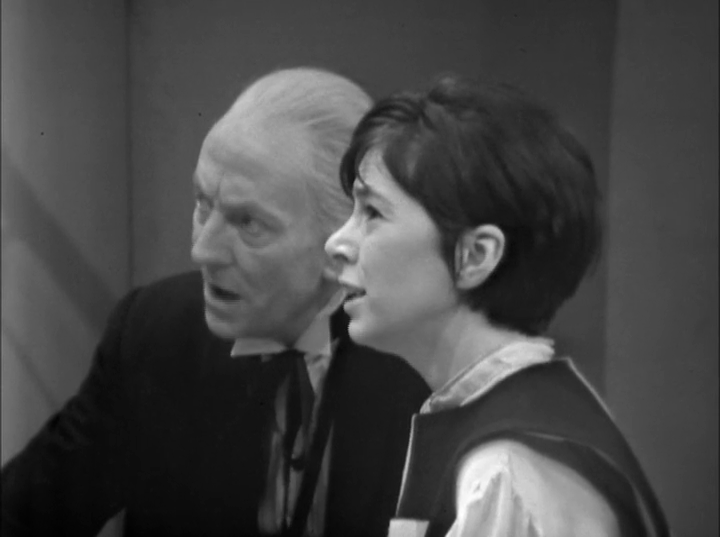
Doctor: William Hartnell (1st Doctor)
Companions: Steven, Dodo
Written by: Brian Hayles (and Donald Tosh)
Directed by: Bill Sellars
Background & Significance: It's hard to think of a story with a sexier title than "The Celestial Toymaker". Part of that is because it comes off as inherently nefarious. Toymaker is the profession of a fellow obsessed with details and driven almost crazy by them. The title also sounds like a worthy adversary for The Doctor ("Celestial", that is, reaching out into the cosmos). And there's always (always!) something alluring about The Doctor going up against a nemesis. It's why The Master is so popular and why people will fetishize both The Monk and The Rani. So why not be excited about this? The title is WONDERFUL.
Because after the title it's all downhill from here.
"The Celestial Toymaker" is one of the few stories that was developed by John Wiles and Donald Tosh, the outgoing producer and script editor. As they developed it, Wiles and Tosh came up with an idea to effectively sideline The Doctor by introducing "The Trilogic Game", which The Doctor would solve while being invisible. In this, Wiles and Tosh (probably mostly Wiles) would circumvent William Hartnell and not have to deal with him, as the relationship between Wiles and Hartnell was openly confrontational/hostile. It's a shrewd move, but one that is at least understandable (if not a bit too passive aggressive for my tastes). And yet, Wiles and Tosh both stepped down from Doctor Who before this episode hit production. Wiles phased himself out during "The Ark" while Tosh stepped down during "The Massacre" to tweak Brian Hayles's scripts so they were ready for Innes Lloyd's producing and Gerry Davis's script editing.
And it's to this day considered a lost treasure.
Part of the reason for this (as Philip Sandifer so eloquently writes up here) is down to one authority deciding that certain stories (like "The Gunfighters") were bad while others (like this one) were good. And yet, outside of the underlying premise (The Doctor and his companions land in a dangerous funland full of evil, nefarious games that might end up killing our heroes) there's really... not much to it. And even with the underlying premise there's not nearly so much as you might instinctively believe. But we'll get to that. For now, know, that I dread this story, but mostly because it's the one last story that I truly hate as we pull into the end of this blog in just a few short months.
So let's get to it!
Showing posts with label Dodo. Show all posts
Tuesday, October 2, 2012
Tuesday, September 27, 2011
Serial 25: The Gunfighters
Doctor: William Hartnell (1st Doctor)
Companions: Steven, DodoWritten by: Donald Cotton Directed by: Rex Tucker
Background & Significance: There's a weird thing in Classic Doctor Who, where incoming producers and script editors are shouldered with some leftover stories commissioned by the previous production team. This happened with the first season of Hinchcliffe/Holmes, in which the two of them were forced to produce a commissioned Dalek story by Terry Nation and a commissioned Cybermen story by Gerry Davis even though Holmes had zero interest in returning Doctor Who villains (especially The Daleks), or even with Nathan-Turner, where he and Chris Bidmead were forced to produce "Meglos" despite knowing that it was totally ensconced in the previous regime's tone and feel rather than their focus on "hard science" (ha!) instead of comedic slapsticky.
"The Gunfighters" is that for Innes Lloyd and Gerry Davis.Commissioned by the previous production team of John Wiles and Donald Tosh, who were interested in another fun historical story from Donald Cotton, who'd previously "succeeded" (as far as they were concerned) with his work on "The Myth-Makers" (which we'll talk about more in a couple of months), this time set in the old west, specifically focusing on the legendary Gunfight at the O.K. Corral with all the tropes and exciting adventures and all that. Much like with "The Myth-Makers", Cotton chose to focus on the spirit of the story rather than being historically accurate (spoilers for "The Myth-Makers": that story isn't "historically" accurate much at all either).
Personally, I think that's a good approach. I think as a rule I'm more interested in the spirit of the thing rather than complete historical accuracy (I am watching a fictional show, after all).Unfortunately, "The Gunfighters" is something of a final gasp of air for historicals. Innes Lloyd and Gerry Davis were more interested in taking Doctor Who to a more serious and science fiction place (hence the hiring of Kit Pedler) and making the show more focused on entertainment and adventure than the educational whatever place it had been for the previous several seasons. It was this team that implemented the first regeneration, after all, and the one that went head on into big sci-fi stories as soon as they could ("The War Machines", "The Tenth Planet", "The Moonbase", just to name a few), employing the base under siege meme in just about all their stories... I mean, the only time they ever even ventured into the past in any sort of way that mattered was when they picked up Jamie in "The Highlanders".
Regardless. I have made my point. This isn't exactly a story they wanted to make, nor is it one that did exceptionally well when it aired, nor is it one that's been well received in the many years since its airing.But the problem, I think, comes from... I dunno, people being stupid, I guess. "The Gunfighters" is basically anything you could ever want out of Doctor Who. It's big and exciting and fun and funny and badass and a super huge huge blast. If only the production team at the time could have seen the merits of making a story in which The Doctor goes to the old west to take care of a toothache, because this is the stuff of good and continues the hypothesis that season three is possibly the weirdest and most eclectic season of Doctor Who that's ever been made. I mean, this story is basically the why of all that.
Tuesday, June 21, 2011
Serial 23: The Ark
Doctor: William Hartnell (1st Doctor)
Companions: Steven, Dodo
Written by: Paul Erickson & Lesley Scott
Directed by: Michael Imerson
Editor's Note: Hey, kids! Matt here! Introducing Cassandra's discussion of "The Ark", which is awesome because it's a totally rad discussion and story. I'll be back next week with more talk, this time about Daleks and Pertwee! Whoo! But for now, Cassandra!
Background & Significance: People generally have good things to say about "The Ark" and, as we'll find out soon, not without good reason.
Written by: Paul Erickson & Lesley Scott
Directed by: Michael Imerson
Editor's Note: Hey, kids! Matt here! Introducing Cassandra's discussion of "The Ark", which is awesome because it's a totally rad discussion and story. I'll be back next week with more talk, this time about Daleks and Pertwee! Whoo! But for now, Cassandra!
Background & Significance: People generally have good things to say about "The Ark" and, as we'll find out soon, not without good reason.

This story comes at the end of the short-lived tenure of producer John Wiles, who actually resigned from the show before this story went into production, but he still gets credit for it, which is cool. He's no Verity Lambert, but if this serial is any indication of his vision of the show, I dig it.
It's also a unique one because this story is the only contribution to the show that both the writers and the director make, which is pretty fascinating to me and a total shame because I think this was pretty well-written and excellently directed. The director, Michael Imerson, apparently overspent way a lot (and it shows, I love the production design, it's so greatness. And
live animals! Unheard of.), and he was the first to break the tradition of filming scenes in episode order (not as they appear during transmission, but to which episodes the scenes belonged), which was the first tiny step in changing the way Doctor Who was made.
This is also Dodo's first full adventure as companion, having been introduced briefly at the end of the previous story, "The Massacre of St. Bartholomew's Eve."
But enough of all that. Let's take a closer look, shall we?
Tuesday, May 31, 2011
Serial 26: The Savages
Doctor: William Hartnell (1st Doctor)Companion: Steven, Dodo
Written by: Ian Stuart Black
Directed by: Christopher Barry
Editor's Note: Hello again! Welcome back to another week! As you probably heard from last week (or whatever) I have the week off and my guest blogger Cassandra is filling in for me on a reconstruction (her first, and it's good). I'll be back next week though. With another reconstruction. Because we do those now. YAY!
And in case you've forgotten, don't forget to
check out The Doctor's Companion, where I'm on every week talking about the new and recent episodes!Background & Significance: Nobody really ever talks about "The Savages." Not that that's a bad thing. But really, it's not a particularly good thing, either.
There's not a lot of buzz on this story, which, having seen it twice, I can understand. It's extremely slow to start, and rather dull in places. It's not an especially remarkable story, really rather standard, but not without its really nifty sci-fi ideas and concepts. Oh, and it doesn't exist anymore.
The plight of the no
nexistent story is one of the most bittersweet things about Doctor Who. Yes, the audio survives and various people can make reconstructions from telesnaps and existing pieces of the video and the audio track, but let's be honest, that's not any way to experience a television show. We've done a few reconstructions here at Classical Gallifrey already, but I've never personally reviewed one, so you'll be getting some more of my thoughts on that a bit later.As far as significance goes, despite the fact that this story is pretty average, it's actually pretty significant for a number of reasons. "The Savages" is not only writer Ian Stuart Black's first story
on the show, but it's also the first serial to be overseen by producer Innes Lloyd and script editor Gerry Davis, so it marks a changing of the guard, if you will. It's also the first ever Doctor Who serial to not have individually titled episodes, which is pretty awesome. Aside from the behind the scenes production significance of this story, it also serves as companion Steven's (as portrayed by actor Peter Purves) last adventure with the Doctor, and companion departures are usually always a pretty big deal across the board.But enough of all that. Let's take a closer look, shall we?
Tuesday, September 7, 2010
Serial 27: The War Machines
Doctor: William Hartnell (1st Doctor)
Companion: Dodo, Ben & Polly
Written by: Ian Stuart Black
Directed by: Michael Ferguson
Background & Significance: As William Hartnell's tenure came to a close, producer Innes Lloyd decided to scrap the idea of historical serials and decided instead to replace them with stories set on present or near-future Earth. This would save on production costs and also help emphasize the science fiction nature of the show.
"The War Machines" is inspired by an idea from Kit Pedler, the scientific advisor Lloyd brought on to the show to make the science more realistic and believable. Pedler, most famous for co-creating the Cybermen, came up with an idea for an evil computer trapped stationary in an office building, unable to escape. In order to work around this small hindrance, it would connect to the outside world via telephone and use machines to conduct business beyond the confines of its oppressive room.
So yeah. Basically he theorized the internet and then developed a proto-Skynet. Decades before James Cameron even got behind the camera to create his Terminator stories.
Wait. And it's The Doctor's job to stop this all? It's The Doctor vs. The Internet! Again!
Also, it's got the introduction of new companions Ben and Polly (who stick around for the next season and witness The Doctor's first regeneration) and also has what is easily the WORST companion departure of all time. No really. It's horrid. It made me laugh.
So let's get to it!
Subscribe to:
Posts (Atom)