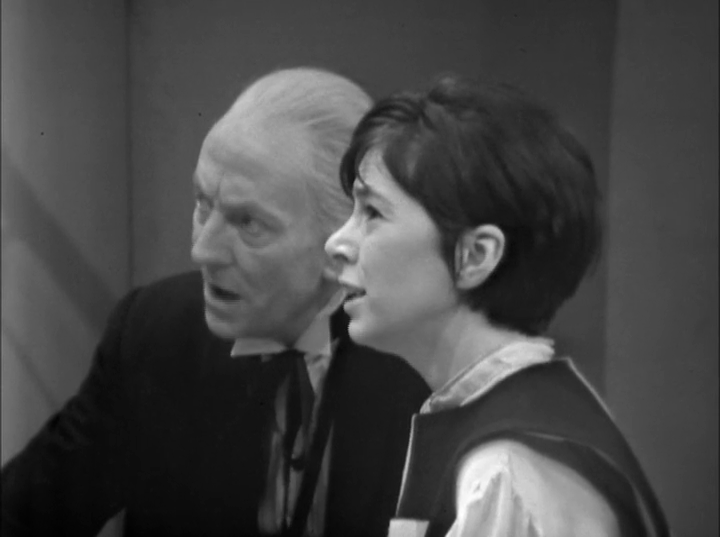
Doctor: Tom Baker (4th Doctor)
Companions: Romana II, K-9
Writtten by: John Flanagan and Andrew McCulloch
Directed by: Terence Dudley
Background & Significance: "Meglos" is one of those infamous little Doctor Who stories. It's unique because it's apparently "one of the few weak Tom Baker stories" (I say that tongue-in-cheekly) and because it's the... odd one out that doesn't quite fit into this, Tom Baker's final season on the show. It's not the kickoff story. Nor is it about E-Space of the return of The Master. So what is it?
I think it's safe to say that it's... a pretty rote and standard Doctor Who affair for being the second Johnathan Nathan-Turner story. Which is exactly what he was worried about, so....
It's strange. I think if anything, this is still one of those stories that's trying to shake off the old reign of the show, that really pushed Nathan-Turner into the paranoid, self-obsessed dude he more-and-more increasingly ended up being as the years went on. He wasn't super hot on "Meglos" in theory (he thought it "a bit too typical even for Who" and "uninspired." I doubt he was hot on the writing team (they never made another story although there were attempts) and he must have at least liked Terence Dudley because he did invite him back (although never in a directing capacity, which either means Dudley is a phenomenal writer (which he's.... ehhhhhhhhhhhh...... alright, I suppose) or Nathan-Turner didn't really care for him as a director.
Or Dudley really enjoys writing.
(Also, interesting to point out: JNT's reservations about this were probably right in the end meaning he could be justified in any future stranglehold he would make over the show or whatever. I mean. With this lack of quality? I would...)
But yes. "Meglos".
There's a lot of interesting mythology around Meglos, although none so uniquely interesting as the story itself. Although other things come close, the most interesting thing (to me, admittedly) is that Gareth Roberts's original pitch for "The Lodger" was designed to have the bad guy turn out to be Meglos in an attempt to wrap up the lasting mystery of this story (of course, the ever elusive "Just who the hell is Meglos and what is his deal?"). Apparently when they were to meet, The Doctor wasn't going to remember Meglos (and honestly, aside for "That cactus thing" what is it that's memorable about him? Come on. That's a fair question).
All this cheeking aside, it does do something interesting for Tom Baker, and that's allow him to be double-cast as the villain of the story, which was done for Troughton in "Enemy of the World" and Hartnell in "The Massacre". My question? Does it work? How does Tom Baker take the opportunity? Well... it's an interesting driving question, I suppose.
So let's get to it!
Tuesday, August 2, 2011
Tuesday, July 26, 2011
Serial 39: The Ice Warriors
Doctor: Patrick Troughton (2nd Doctor)Companions: Jamie, Victoria
Written by: Brian Hayles
Directed by: Derek Martinus
Editor's Note: Hey guys! Matt here stepping in real quick to mention that this week's blog is brought to you by Cassandra, who crushed it when talking about this week's story. But never fear! I'll be back next week with some thoughts on "Meglos", and as always keep checking out "The Doctor's Companion" for even more Classic Who discussion. Awesome stuff coming up. BUT FIRST! I'll let Cassandra kick things off!
Background & Significance: Ice Warriors, mofos!
I'm really excited to talk about this story because this is the first Troughton story I get to discuss, and I love Ice Warriors. Like, love. I don't care that they look silly or they hiss and it's hard to understand what they're talking about. They're freaking sweet.Of course, this is the first story featuring the Martian race known as the Ice Warriors, and it's a really great first outing for them. Creator (and writer of this and every subsequent Classic story involving the Ice Warriors) Brian Hayles was approached by producer Innes Lloyd and script editor Peter Bryant to create a new recurring alien race for the Doctor to go up against, much like the Daleks and the Cybermen. Of course, the Ice Warriors wouldn't be utilized as often--they only show up in three stories after this one--but they're still, in my humble opinion, a great and iconic Doctor Who villain.
This story also deals with the idea of weather manipulation, which is a recurring theme in this era, starting with "The Moonbase". While so scientifically inaccurate it's insane, it's a lot of fun to be able to trace the various ideas people were entertaining at the time and how that bleeds into the social consciousness through a popular show like Doctor Who.Of course, this is one of those stories thought lost to the ages at first, but thankfully was mostly recovered, with only two out of the six episodes missing (which is quite lucky, when you consider all the other stories missing in their entirety).
But enough of all that. Let's take a closer look, shall we?
Tuesday, July 19, 2011
Serial 4: Marco Polo
Doctor: William Hartnell (1st Doctor)
Companions: Susan, Barbara, & Ian
Writtten by: John Lucarotti
Directed by: Waris Hussein
Background & Significance: "Marco Polo" is something of a legendary Doctor Who story. For starters, it's the chronological "first" story with missing episodes in the entire Doctor Who catalog; not only that, even, but it's the first story that is missing in its entirety. Missing stories, of course, are endlessly elusive in the eyes of the fans. The promise of what exists beyond cheap and blurry screencaps and a cleaned-up-but-not-perfect audio recording of the episode will always have that air of curiosity to it, even if the story doesn't really end up delivering in the end (this is the point when I call out "The Space Pirates").
But Marco Polo is different.
Because all that survives of Marco Polo is its soundtrack and a couple of photographs from director Waris Hussein's personal library, the promise has perhaps never been greater. What we see on the images promises sets that were gorgeous and lush. Something with a fairly big budget and that would capitalize on the always-so-famous BBC period drama showcase. What we hear in the dialogue is rather strong and excellent. What we experience from the story is thrilling, simple, and intricate. As such, "Marco Polo" is the first real historical, and it's a historical epic at that ("Unearthly Child" doesn't quite count, as that's more adventure than historical educational) taps into the promise of early Doctor Who, when the basic conceit of the show was one that alternated between science fiction for one story and then historical for the second, with little to no sci-fi elements beyond the basic premise of "These traveling dudes landed in this time. Isn't that cool?"
Not only that, but this is the first story to air after the initial thirteen episodes, the ones that were Doctor Who's basic trial run and initial pickup. After "The Edge of Destruction", producer Verity Lambert was allowed to continue on with "Marco Polo" and the show as a whole. So that's neat from an external "isn't this cool" standpoint. But from an internal, what-is-happening-in-the-narrative standpoint, the show has gelled completely, with the main characters taking the lessons from the short-but-sweet "Edge of Destruction" and advancing the narrative of them working as a trusting team. No longer do Barbara and Ian question The Doctor at every single turn (only a couple of times, I'd say). No longer does The Doctor act like a murderous git. No. Well. Sort of. That stuff's still there. BUT REGARDLESS. This is when the show is allowed to breathe some more and take its time to get to what it's doing.
And this all adds up to what is a legendary story. Not only that, but what is (perhaps) the greatest tragedy of the erased episodes from the missing BBC archives, because man is this just a total gem.
So let's get to it!
Companions: Susan, Barbara, & Ian
Writtten by: John Lucarotti
Directed by: Waris Hussein
Background & Significance: "Marco Polo" is something of a legendary Doctor Who story. For starters, it's the chronological "first" story with missing episodes in the entire Doctor Who catalog; not only that, even, but it's the first story that is missing in its entirety. Missing stories, of course, are endlessly elusive in the eyes of the fans. The promise of what exists beyond cheap and blurry screencaps and a cleaned-up-but-not-perfect audio recording of the episode will always have that air of curiosity to it, even if the story doesn't really end up delivering in the end (this is the point when I call out "The Space Pirates").
Because all that survives of Marco Polo is its soundtrack and a couple of photographs from director Waris Hussein's personal library, the promise has perhaps never been greater. What we see on the images promises sets that were gorgeous and lush. Something with a fairly big budget and that would capitalize on the always-so-famous BBC period drama showcase. What we hear in the dialogue is rather strong and excellent. What we experience from the story is thrilling, simple, and intricate. As such, "Marco Polo" is the first real historical, and it's a historical epic at that ("Unearthly Child" doesn't quite count, as that's more adventure than historical educational) taps into the promise of early Doctor Who, when the basic conceit of the show was one that alternated between science fiction for one story and then historical for the second, with little to no sci-fi elements beyond the basic premise of "These traveling dudes landed in this time. Isn't that cool?"
Not only that, but this is the first story to air after the initial thirteen episodes, the ones that were Doctor Who's basic trial run and initial pickup. After "The Edge of Destruction", producer Verity Lambert was allowed to continue on with "Marco Polo" and the show as a whole. So that's neat from an external "isn't this cool" standpoint. But from an internal, what-is-happening-in-the-narrative standpoint, the show has gelled completely, with the main characters taking the lessons from the short-but-sweet "Edge of Destruction" and advancing the narrative of them working as a trusting team. No longer do Barbara and Ian question The Doctor at every single turn (only a couple of times, I'd say). No longer does The Doctor act like a murderous git. No. Well. Sort of. That stuff's still there. BUT REGARDLESS. This is when the show is allowed to breathe some more and take its time to get to what it's doing.
And this all adds up to what is a legendary story. Not only that, but what is (perhaps) the greatest tragedy of the erased episodes from the missing BBC archives, because man is this just a total gem.
So let's get to it!
Thursday, July 14, 2011
Serial 19: Mission to the Unknown
Doctor: None?
Companions: None?
Written by: Terry Nation
Directed by: Derek Martinus
Background & Significance: Leave it to Terry Nation to come up with titles that mean no sense.
"Mission to the Unknown" is something of an odd bird. Perhaps the most obvious of these is that there is neither sign nor reference to The Doctor or his current companions (Vicki and Steven at the time; about to become Steven and Katarina) and all that we have in sight are The Daleks and their allies for the forthcoming epic "The Daleks' Master Plan".
So really, it's like a prologue.
If that sounds weird, that's because it is. It doesn't feel like Doctor Who, nor (do I think) is it supposed to. The show was about to capitalize on the last gasp of Dalekmania before the Daleks went into a four year retirement between the back two seasons of Hartnell and the first two of Troughton. At the time, Terry Nation was attempting to capitalize on his most famous creations, working on getting a Dalek television show made. As such, this becomes an almost backdoor pilot to what would have been a Dalek television series (think something like a Dalek show starring Sara Kingdom as head of a counter-Dalek squad or something). So it... Yeah. It's weird. But they got away with it, I guess.
It also marks the final contribution to the show by producer Verity Lambert, which is also strange. You'd think she'd go out on a bit of a higher note. But no, she goes out on a quiet, experimental, Doctorless story. Which is strange to me. After this John Wiles takes over. And that's all fun. But... yeah.
Also, as one final point of ego-boosting background: This is the halfway point for the blog. Apparently we've so far covered the first half of Classic Doctor Who, meaning it's all downhill from here. I know you probably don't care, but ummmm... Yeah. Milestone. Go us. Go team. Go everybody.
So let's get to it!
Companions: None?
Written by: Terry Nation
Directed by: Derek Martinus
Background & Significance: Leave it to Terry Nation to come up with titles that mean no sense.
"Mission to the Unknown" is something of an odd bird. Perhaps the most obvious of these is that there is neither sign nor reference to The Doctor or his current companions (Vicki and Steven at the time; about to become Steven and Katarina) and all that we have in sight are The Daleks and their allies for the forthcoming epic "The Daleks' Master Plan".
So really, it's like a prologue.
If that sounds weird, that's because it is. It doesn't feel like Doctor Who, nor (do I think) is it supposed to. The show was about to capitalize on the last gasp of Dalekmania before the Daleks went into a four year retirement between the back two seasons of Hartnell and the first two of Troughton. At the time, Terry Nation was attempting to capitalize on his most famous creations, working on getting a Dalek television show made. As such, this becomes an almost backdoor pilot to what would have been a Dalek television series (think something like a Dalek show starring Sara Kingdom as head of a counter-Dalek squad or something). So it... Yeah. It's weird. But they got away with it, I guess.
It also marks the final contribution to the show by producer Verity Lambert, which is also strange. You'd think she'd go out on a bit of a higher note. But no, she goes out on a quiet, experimental, Doctorless story. Which is strange to me. After this John Wiles takes over. And that's all fun. But... yeah.
Also, as one final point of ego-boosting background: This is the halfway point for the blog. Apparently we've so far covered the first half of Classic Doctor Who, meaning it's all downhill from here. I know you probably don't care, but ummmm... Yeah. Milestone. Go us. Go team. Go everybody.
So let's get to it!
Tuesday, July 12, 2011
Serial 107: The Nightmare of Eden
Doctor: Tom Baker (4th Doctor)
Companions: Romana II, K-9
Writtten by: Bob Baker
Directed by: Alan Bromly
Background & Significance: Just so you know, the title is a drug reference.
"The Nightmare of Eden" is something of an odd bird if you ask me. By all rights I shouldn't really like this story. It's written by one half of the team that has brought me so much pain in Classic Doctor Who, it's in Graham Williams's final season, Douglas Adams's only season, is done on the remarkable cheap, and features an appearance by David Brierly, also known as "The Imposter K-9".
And yet, I think it's actually rather good.
That's not to say the story didn't have everything going against it. Director Alan Bromly was last seen directing The Doctor in the very excellent "The Time Warrior" and was pulled out of retirement based on his perceived interest in the subject matter. Unfortunately, Bromly himself came from a different era of TV direction, in which a director was allowed an authoritarian level of control over his set and vision of the story. Sure, this worked well for Jon Pertwee some six or seven years earlier. But this is a different time. Yes yes. Of course, Bromly's vision brought him straight into conflict with Doctor Who primadonna Tom Baker, who was used to getting his way on the programme and what have you.
So naturally, there was conflict.
Between that and Lalla Ward (and plenty of other peoples) wanting to make sure the drugs in the story were never portrayed as anything even remotely close to positive, it's... quite the gauntlet this story has to run to get made. But strangely, I really think it's stronger for it, regardless of the behind the scenes stuff, which apparently erupted into on-set shouting matches between Tom Baker and the director, culminating in Bromly walking off the project on the final day during the supper break and Graham Williams being forced to step in to complete work on the production and post-production of the serial, which in turn led to Graham Williams's last straw and his departure from the programme at the end of the year...
Which... kinda makes this a turning point really sorta. Kinda. Sorta.
Anyways. It's time to get talking about some drug running.
So let's get to it!
Companions: Romana II, K-9
Writtten by: Bob Baker
Directed by: Alan Bromly
Background & Significance: Just so you know, the title is a drug reference.
"The Nightmare of Eden" is something of an odd bird if you ask me. By all rights I shouldn't really like this story. It's written by one half of the team that has brought me so much pain in Classic Doctor Who, it's in Graham Williams's final season, Douglas Adams's only season, is done on the remarkable cheap, and features an appearance by David Brierly, also known as "The Imposter K-9".
And yet, I think it's actually rather good.
That's not to say the story didn't have everything going against it. Director Alan Bromly was last seen directing The Doctor in the very excellent "The Time Warrior" and was pulled out of retirement based on his perceived interest in the subject matter. Unfortunately, Bromly himself came from a different era of TV direction, in which a director was allowed an authoritarian level of control over his set and vision of the story. Sure, this worked well for Jon Pertwee some six or seven years earlier. But this is a different time. Yes yes. Of course, Bromly's vision brought him straight into conflict with Doctor Who primadonna Tom Baker, who was used to getting his way on the programme and what have you.
So naturally, there was conflict.
Between that and Lalla Ward (and plenty of other peoples) wanting to make sure the drugs in the story were never portrayed as anything even remotely close to positive, it's... quite the gauntlet this story has to run to get made. But strangely, I really think it's stronger for it, regardless of the behind the scenes stuff, which apparently erupted into on-set shouting matches between Tom Baker and the director, culminating in Bromly walking off the project on the final day during the supper break and Graham Williams being forced to step in to complete work on the production and post-production of the serial, which in turn led to Graham Williams's last straw and his departure from the programme at the end of the year...
Which... kinda makes this a turning point really sorta. Kinda. Sorta.
Anyways. It's time to get talking about some drug running.
So let's get to it!
Tuesday, July 5, 2011
Serial 49: The Space Pirates
Doctor: Patrick Troughton (2nd Doctor)
Companions: Jamie, Zoe
Writtten by: Robert Holmes
Directed by: Michael Hart
Background & Significance: "The Space Pirates" will forever be remembered as "The One Before The War Games", and that's not just because "The War Games" is so influential and spanning and all-important. The regulars and the cast and crew themselves were in a bit of a transitionary phase while the show prepared to undergo what was essentially a square one reboot.
By season six, Patrick Troughton's final season, Doctor Who as a show was starting to become a bit tired. Nevermind Troughton himself, who cited the rigorous television schedule as grueling and tiring without any prompting from anyone else, but to have a show like Doctor Who with all its scifiness and special effects and shooting schedules etc. produce an average of over forty two stories per year, week in, week out for six years would be exhausting to any production team, and it's no wonder, therefore, that the show needed to slow down and take measure of itself and return to a place of quality or what have you. So in a lot of ways, "The War Games" becomes the last final sprint of what was essentially (at that point) weekly Doctor Who, and its quality reflects that last, final burst of energy to get it across the finish line, almost atypical in how frakking good it ended up being.
And that leaves "The Space Pirates", which is essentially the shadow of that tired show limping along before that final burst of speed.
When you start to get into the nitty gritty of Troughton's final season, it's clear to see that the production crew was absolutely languishing. "The Dominators" was supposed to be six episodes, but they trimmed it to five to enhance the quality of the remaining story. "The Invasion" was as long as it was to stall for time as other things got ready. Doctor Who legend Terrence Dicks (arguably one of the most important figures in Doctor Who's history) was emergency-promoted from assistant script editor to script editor due to outgoing script editor Derrick Sherwin's continued influence in becoming producer on the show. Dicks himself was pulled off of script editing duties towards the end of the season to co-write "The War Games" with Malcolm Hulke with Sherwin stepping in to fill in for this story, "The Space Pirates", and because of the massive scope and the finale's ten episode length, The Doctor and his companions had to pre-film their contribution to episode six.
Clearly, the behind-the-scenes of Doctor Who by this point was just... a nightmare, trying to keep the ship afloat long enough to make it to the complete relaunch with "Spearhead From Space".
Sorry. I'm rambling. Anyways...
"The Space Pirates" is writer Robert Holmes's second contribution to Doctor Who after a strong initial outing in "The Krotons". Unfortunately, "The Krotons" was meant to be the penultimate story for season six, but when the planned fourth story of the season had to be abandoned, "The Krotons" was pushed up to take its place and "The Space Pirates" was born to fill the spot left by "The Krotons." (See? Season six. Huge mess.)
The story itself is one that isn't regarded too strongly by the fandom. Most infamously for most, The Doctor and his companions don't show up until fifteen minutes into the first episode and then stays largely removed from most of the action until well into the third episode. There's probably many reasons for this, not the least of which is Holmes's own recollection that he turned in a four-part story and then was quickly asked to expand it into six parts. That alone sets off warning bells in my head, but my god... Talk about the signs of age and just stretching things out until they can make it to that glorious glorious finale and everyone can sleep a bit more.
But enough talking about silly politics. We're here to talk about some god damn Space Pirates! (Or are we?)
Companions: Jamie, Zoe
Writtten by: Robert Holmes
Directed by: Michael Hart
Background & Significance: "The Space Pirates" will forever be remembered as "The One Before The War Games", and that's not just because "The War Games" is so influential and spanning and all-important. The regulars and the cast and crew themselves were in a bit of a transitionary phase while the show prepared to undergo what was essentially a square one reboot.
By season six, Patrick Troughton's final season, Doctor Who as a show was starting to become a bit tired. Nevermind Troughton himself, who cited the rigorous television schedule as grueling and tiring without any prompting from anyone else, but to have a show like Doctor Who with all its scifiness and special effects and shooting schedules etc. produce an average of over forty two stories per year, week in, week out for six years would be exhausting to any production team, and it's no wonder, therefore, that the show needed to slow down and take measure of itself and return to a place of quality or what have you. So in a lot of ways, "The War Games" becomes the last final sprint of what was essentially (at that point) weekly Doctor Who, and its quality reflects that last, final burst of energy to get it across the finish line, almost atypical in how frakking good it ended up being.
And that leaves "The Space Pirates", which is essentially the shadow of that tired show limping along before that final burst of speed.
When you start to get into the nitty gritty of Troughton's final season, it's clear to see that the production crew was absolutely languishing. "The Dominators" was supposed to be six episodes, but they trimmed it to five to enhance the quality of the remaining story. "The Invasion" was as long as it was to stall for time as other things got ready. Doctor Who legend Terrence Dicks (arguably one of the most important figures in Doctor Who's history) was emergency-promoted from assistant script editor to script editor due to outgoing script editor Derrick Sherwin's continued influence in becoming producer on the show. Dicks himself was pulled off of script editing duties towards the end of the season to co-write "The War Games" with Malcolm Hulke with Sherwin stepping in to fill in for this story, "The Space Pirates", and because of the massive scope and the finale's ten episode length, The Doctor and his companions had to pre-film their contribution to episode six.
Clearly, the behind-the-scenes of Doctor Who by this point was just... a nightmare, trying to keep the ship afloat long enough to make it to the complete relaunch with "Spearhead From Space".
Sorry. I'm rambling. Anyways...
"The Space Pirates" is writer Robert Holmes's second contribution to Doctor Who after a strong initial outing in "The Krotons". Unfortunately, "The Krotons" was meant to be the penultimate story for season six, but when the planned fourth story of the season had to be abandoned, "The Krotons" was pushed up to take its place and "The Space Pirates" was born to fill the spot left by "The Krotons." (See? Season six. Huge mess.)
The story itself is one that isn't regarded too strongly by the fandom. Most infamously for most, The Doctor and his companions don't show up until fifteen minutes into the first episode and then stays largely removed from most of the action until well into the third episode. There's probably many reasons for this, not the least of which is Holmes's own recollection that he turned in a four-part story and then was quickly asked to expand it into six parts. That alone sets off warning bells in my head, but my god... Talk about the signs of age and just stretching things out until they can make it to that glorious glorious finale and everyone can sleep a bit more.
But enough talking about silly politics. We're here to talk about some god damn Space Pirates! (Or are we?)
So let's get to it!
Tuesday, June 28, 2011
Serial 72: Death to the Daleks
Doctor: Jon Pertwee (3rd Doctor)Companions: Sarah Jane
Written by: Terry Nation
Directed by: Michael Briant
Background & Significance: My question? What's up with the title?
Pertwee's final season is something of an odd bird. For one thing, we're long past the point where The Doctor is having proper UNIT adventures, so he's s free to swan off to wherever and whenever he wants, and he does. Which is good and he earned it and I'm happy for him... But it feels...
This story sees the return of the Daleks for the third season in a row. It's weird how The Daleks always move in waves. They appear like crazy in the Dalekmania of the first four seasons of Doctor Who and then just kinda... disappear for the rest of Troughton's run and then for the first two years of Pertwee and then appear like clockwork for four years. Although it's interesting to see how much the Daleks just become your standard, rote villains after a so many rote and unimportant or uninteresting appearances. They've just shown up too much and they've become stagnant (after just three Pertwee appearances), so it was time for The Daleks to get a massive, game-changing reboot in "Genesis of the Daleks", but I suppose that's another discussion.
It also sees the return of Terry Nation for Doctor Who. Nation, of course, gets first crack at writing any Dalek story because... god knows creative rights (which I'm all for, I just wish Nation was a better writer), but... man. Terry Nation. But I'll save the rest of that thought for commentary.As a final point before we dive head long into the bulk of the discussion, it was around this time that Pertwee was starting to really become disillusioned with the programme, bored and ready to move on and all that. Of course this disillusionment/boredom happens with a Dalek story. I mean, Pertwee never exactly kept it secret that he totally never ever did have a thing for the fan-favourite pepper potts.
But with the slow weaning off of Pertwee we get the prominence of Robert Holmes, who you can almost feel conducting the background of the first episode at the very least. And... well... you know me. I loves me some Robert Holmes.
So let's get to it!
Tuesday, June 21, 2011
Serial 23: The Ark
Doctor: William Hartnell (1st Doctor)
Companions: Steven, Dodo
Written by: Paul Erickson & Lesley Scott
Directed by: Michael Imerson
Editor's Note: Hey, kids! Matt here! Introducing Cassandra's discussion of "The Ark", which is awesome because it's a totally rad discussion and story. I'll be back next week with more talk, this time about Daleks and Pertwee! Whoo! But for now, Cassandra!
Background & Significance: People generally have good things to say about "The Ark" and, as we'll find out soon, not without good reason.
Written by: Paul Erickson & Lesley Scott
Directed by: Michael Imerson
Editor's Note: Hey, kids! Matt here! Introducing Cassandra's discussion of "The Ark", which is awesome because it's a totally rad discussion and story. I'll be back next week with more talk, this time about Daleks and Pertwee! Whoo! But for now, Cassandra!
Background & Significance: People generally have good things to say about "The Ark" and, as we'll find out soon, not without good reason.

This story comes at the end of the short-lived tenure of producer John Wiles, who actually resigned from the show before this story went into production, but he still gets credit for it, which is cool. He's no Verity Lambert, but if this serial is any indication of his vision of the show, I dig it.
It's also a unique one because this story is the only contribution to the show that both the writers and the director make, which is pretty fascinating to me and a total shame because I think this was pretty well-written and excellently directed. The director, Michael Imerson, apparently overspent way a lot (and it shows, I love the production design, it's so greatness. And
live animals! Unheard of.), and he was the first to break the tradition of filming scenes in episode order (not as they appear during transmission, but to which episodes the scenes belonged), which was the first tiny step in changing the way Doctor Who was made.
This is also Dodo's first full adventure as companion, having been introduced briefly at the end of the previous story, "The Massacre of St. Bartholomew's Eve."
But enough of all that. Let's take a closer look, shall we?
Tuesday, June 14, 2011
Serial 128: The King's Demons
Doctor: Peter Davison (5th Doctor)
Companions: Tegan, Turlough, Kamelion
Writtten by: Terence Dudley
Directed by: Tony Virgo
Background & Significance: Now here's an odd one.
"The King's Demons" is one of the few two parters in Classic Who history, and it's something of a strange thing as a result. For one thing, these two parters are usually a bit of diversionary fun, but often structured strangely.
For one thing, they usually build like the first part of a four parter and then resolve and deal with complications rather quickly. In fact, there's rarely actually any sort of complication to them. They just sorta happen. Like I said, diversionary.
Terence Dudley, if you'll remember, is the fellow who did the script to "Black Orchid", which was also a two-parter. That, like this, was a bit of diversionary fun, something to intermissioncise the season between two stories--whatever was coming up supposedly being major or whatever. In this case, the plan was for "The King's Demons" to fall between the "massive" Black Guardian Trilogy and Eric Saward's revival of The Daleks in what was supposed to be called "The Return" but which turned into "Resurrection of the Daleks" a season later when it was postponed from this season (season 20) due to a labour strike (which was becoming far too common, if you ask me).
So it only makes sense that "The King's Demons" come here. I mean, The Daleks were about to come back. And now we're going to give The Doctor a cool, new, in-no-way-like-C-3PO robot companion with which he can use to fight The Daleks? Awesome. I approve.
Oh if only it were that simple.
So yes, this is the beginning of the Kamelion disaster, Kamelion being a robot so awesome he only made one other appearance in the life of the show. And rightfully so, because he totally was a botched attempt and not wonderfully realized or given that real chance to shine or whatever, but I'm sure I can talk about that as I go through it or something. Especially in part two.
Also fun to point out: it's Season 20! So we get the return of a villain. Last time we talked about this season, we talked about Omega (which was a genius callback, kids; seriously genius), but now we're at the tail end of the season and we get... Oh. We get The Master, again.
You can feel the wear and tear on the show. Producer Jonathan Nathan Turner's original plan to include The Master at least two times a season was quickly sidelined in favour of other stories that were, quite frankly, better. Also, the last time The Master showed up it was so super sucky that it makes you want to put a gun in your mouth. This is another almost famously infamous Master-is-totally useless story. Which is weird because if they had just gone straight pseudo-historical with this or maybe had the Monk (there's an idea, Captain Jonathan "Callback" Nathan-Turner) or something this would turn out a bit more interesting, but... alas, I suppose.
Companions: Tegan, Turlough, Kamelion
Writtten by: Terence Dudley
Directed by: Tony Virgo
Background & Significance: Now here's an odd one.
"The King's Demons" is one of the few two parters in Classic Who history, and it's something of a strange thing as a result. For one thing, these two parters are usually a bit of diversionary fun, but often structured strangely.
For one thing, they usually build like the first part of a four parter and then resolve and deal with complications rather quickly. In fact, there's rarely actually any sort of complication to them. They just sorta happen. Like I said, diversionary.
Terence Dudley, if you'll remember, is the fellow who did the script to "Black Orchid", which was also a two-parter. That, like this, was a bit of diversionary fun, something to intermissioncise the season between two stories--whatever was coming up supposedly being major or whatever. In this case, the plan was for "The King's Demons" to fall between the "massive" Black Guardian Trilogy and Eric Saward's revival of The Daleks in what was supposed to be called "The Return" but which turned into "Resurrection of the Daleks" a season later when it was postponed from this season (season 20) due to a labour strike (which was becoming far too common, if you ask me).
So it only makes sense that "The King's Demons" come here. I mean, The Daleks were about to come back. And now we're going to give The Doctor a cool, new, in-no-way-like-C-3PO robot companion with which he can use to fight The Daleks? Awesome. I approve.
Oh if only it were that simple.
So yes, this is the beginning of the Kamelion disaster, Kamelion being a robot so awesome he only made one other appearance in the life of the show. And rightfully so, because he totally was a botched attempt and not wonderfully realized or given that real chance to shine or whatever, but I'm sure I can talk about that as I go through it or something. Especially in part two.
Also fun to point out: it's Season 20! So we get the return of a villain. Last time we talked about this season, we talked about Omega (which was a genius callback, kids; seriously genius), but now we're at the tail end of the season and we get... Oh. We get The Master, again.
You can feel the wear and tear on the show. Producer Jonathan Nathan Turner's original plan to include The Master at least two times a season was quickly sidelined in favour of other stories that were, quite frankly, better. Also, the last time The Master showed up it was so super sucky that it makes you want to put a gun in your mouth. This is another almost famously infamous Master-is-totally useless story. Which is weird because if they had just gone straight pseudo-historical with this or maybe had the Monk (there's an idea, Captain Jonathan "Callback" Nathan-Turner) or something this would turn out a bit more interesting, but... alas, I suppose.
So let's get to it!
Tuesday, June 7, 2011
Serial 35: The Faceless Ones
Doctor: Patrick Troughton (2nd Doctor)
Companion: Jamie, Ben & Polly
Written by: David Ellis and Malcolm Hulke
Directed by: Gerry Mill
Background & Significance: It's basically Troughton's "Time-Flight"?
Straight off, it should be noted that "The Faceless Ones" continues the trend of badass Troughton titles. See, I'm a huge fan of titles in general, and different eras have different feels of titles and such. The Davison titles, for instance, have a grand feeling of mysterious/ominous adventures, be that for good or ill. Troughton's stories always feel like straight up sci-fi adventures that just feel really classic and pulpy such as "Tomb of the Cybermen", "The Moonbase", "The Mind Robber", "The Ice Warriors", and "Fury From the Deep". "The Faceless Ones" is no exception and it gives a clear cut answer as to what is the big worry of the story.
Hint: It's whatever "The Faceless Ones" are.
But even beyond the title, I suppose "The Faceless Ones" is........ a story? It's the first story written (co-written really) by the quite good Malcolm Hulke and it's the final story featuring Ben and Polly (although that's a really weird thing as I'm sure I'll make fun of as we go through it), so it's got some significance and all, but... man. I couldn't tell you the good or the strong things about this story, not after the first episode or two anyways. The story itself is about airplanes disappearing and is quite clever in a lot of respects, but....
Actually, I will say that producer Innes Lloyd broke some rules here and did a six part story after doing an entire season's worth (nine stories minus one) of four-part stories.
Ah, the trap of the six part story. How it fails you, I think. It's an easy and enticing proposition, but man does it screw you in the end because holy crap this doesn't need to be six parts. No way. Make this four and tight and it might be watchable, but me? Yikes. I'm hoping I don't lose interest partway through part three. Cuz this might be a long ass blog. Ugh.
So let's get to it!
Companion: Jamie, Ben & Polly
Written by: David Ellis and Malcolm Hulke
Directed by: Gerry Mill
Background & Significance: It's basically Troughton's "Time-Flight"?
Straight off, it should be noted that "The Faceless Ones" continues the trend of badass Troughton titles. See, I'm a huge fan of titles in general, and different eras have different feels of titles and such. The Davison titles, for instance, have a grand feeling of mysterious/ominous adventures, be that for good or ill. Troughton's stories always feel like straight up sci-fi adventures that just feel really classic and pulpy such as "Tomb of the Cybermen", "The Moonbase", "The Mind Robber", "The Ice Warriors", and "Fury From the Deep". "The Faceless Ones" is no exception and it gives a clear cut answer as to what is the big worry of the story.
Hint: It's whatever "The Faceless Ones" are.
But even beyond the title, I suppose "The Faceless Ones" is........ a story? It's the first story written (co-written really) by the quite good Malcolm Hulke and it's the final story featuring Ben and Polly (although that's a really weird thing as I'm sure I'll make fun of as we go through it), so it's got some significance and all, but... man. I couldn't tell you the good or the strong things about this story, not after the first episode or two anyways. The story itself is about airplanes disappearing and is quite clever in a lot of respects, but....
Actually, I will say that producer Innes Lloyd broke some rules here and did a six part story after doing an entire season's worth (nine stories minus one) of four-part stories.
Ah, the trap of the six part story. How it fails you, I think. It's an easy and enticing proposition, but man does it screw you in the end because holy crap this doesn't need to be six parts. No way. Make this four and tight and it might be watchable, but me? Yikes. I'm hoping I don't lose interest partway through part three. Cuz this might be a long ass blog. Ugh.
So let's get to it!
Subscribe to:
Posts (Atom)