Tuesday, July 5, 2011

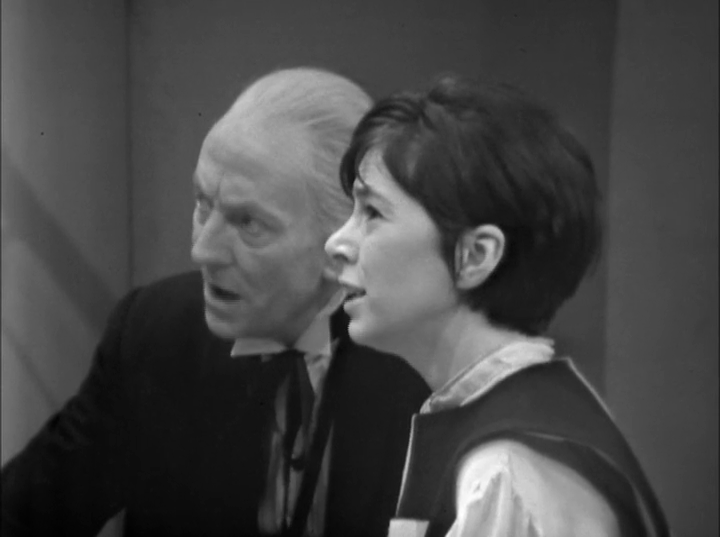
Serial 49: The Space Pirates

Doctor: Patrick Troughton (2nd Doctor)
Companions: Jamie, Zoe

Writtten by: Robert Holmes

Directed by: Michael Hart

Background & Significance:
"The Space Pirates" will forever be remembered as "The One Before The War Games", and that's not just because "The War Games" is so influential and spanning and all-important. The regulars and the cast and crew themselves were in a bit of a transitionary phase while the show prepared to undergo what was essentially a square one reboot.

By season six, Patrick Troughton's final season, Doctor Who as a show was starting to become a bit tired. Nevermind Troughton himself, who cited the rigorous television schedule as grueling and tiring without any prompting from anyone else, but to have a show like Doctor Who with all its scifiness and special effects and shooting schedules etc. produce an average of over forty two stories per year, week in, week out for six years would be exhausting to any production team, and it's no wonder, therefore, that the show needed to slow down and take measure of itself and return to a place of quality or what have you. So in a lot of ways, "The War Games" becomes the last final sprint of what was essentially (at that point) weekly Doctor Who, and its quality reflects that last, final burst of energy to get it across the finish line, almost atypical in how frakking good it ended up being.

And that leaves "The Space Pirates", which is essentially the shadow of that tired show limping along before that final burst of speed.

When you start to get into the nitty gritty of Troughton's final season, it's clear to see that the production crew was absolutely languishing. "The Dominators" was supposed to be six episodes, but they trimmed it to five to enhance the quality of the remaining story. "The Invasion" was as long as it was to stall for time as other things got ready. Doctor Who legend Terrence Dicks (arguably one of the most important figures in Doctor Who's history) was emergency-promoted from assistant script editor to script editor due to outgoing script editor Derrick Sherwin's continued influence in becoming producer on the show. Dicks himself was pulled off of script editing duties towards the end of the season to co-write "The War Games" with Malcolm Hulke with Sherwin stepping in to fill in for this story, "The Space Pirates", and because of the massive scope and the finale's ten episode length, The Doctor and his companions had to pre-film their contribution to episode six.

Clearly, the behind-the-scenes of Doctor Who by this point was just... a nightmare, trying to keep the ship afloat long enough to make it to the complete relaunch with "Spearhead From Space".

Sorry. I'm rambling. Anyways...

"The Space Pirates" is writer Robert Holmes's second contribution to Doctor Who after a strong initial outing in "The Krotons". Unfortunately, "The Krotons" was meant to be the penultimate story for season six, but when the planned fourth story of the season had to be abandoned, "The Krotons" was pushed up to take its place and "The Space Pirates" was born to fill the spot left by "The Krotons." (See? Season six. Huge mess.)

The story itself is one that isn't regarded too strongly by the fandom. Most infamously for most, The Doctor and his companions don't show up until fifteen minutes into the first episode and then stays largely removed from most of the action until well into the third episode. There's probably many reasons for this, not the least of which is Holmes's own recollection that he turned in a four-part story and then was quickly asked to expand it into six parts. That alone sets off warning bells in my head, but my god... Talk about the signs of age and just stretching things out until they can make it to that glorious glorious finale and everyone can sleep a bit more.

But enough talking about silly politics. We're here to talk about some god damn Space Pirates! (Or are we?)

So let's get to it!

Tuesday, June 28, 2011

Serial 72: Death to the Daleks

Doctor: Jon Pertwee (3rd Doctor)
Companions: Sarah Jane

Written by: Terry Nation
Directed by: Michael Briant

Background & Significance: My question? What's up with the title?

Pertwee's final season is something of an odd bird. For one thing, we're long past the point where The Doctor is having proper UNIT adventures, so he's s free to swan off to wherever and whenever he wants, and he does. Which is good and he earned it and I'm happy for him... But it feels...

This story sees the return of the Daleks for the third season in a row. It's weird how The Daleks always move in waves. They appear like crazy in the Dalekmania of the first four seasons of Doctor Who and then just kinda... disappear for the rest of Troughton's run and then for the first two years of Pertwee and then appear like clockwork for four years. Although it's interesting to see how much the Daleks just become your standard, rote villains after a so many rote and unimportant or uninteresting appearances. They've just shown up too much and they've become stagnant (after just three Pertwee appearances), so it was time for The Daleks to get a massive, game-changing reboot in "Genesis of the Daleks", but I suppose that's another discussion.

It also sees the return of Terry Nation for Doctor Who. Nation, of course, gets first crack at writing any Dalek story because... god knows creative rights (which I'm all for, I just wish Nation was a better writer), but... man. Terry Nation. But I'll save the rest of that thought for commentary.

As a final point before we dive head long into the bulk of the discussion, it was around this time that Pertwee was starting to really become disillusioned with the programme, bored and ready to move on and all that. Of course this disillusionment/boredom happens with a Dalek story. I mean, Pertwee never exactly kept it secret that he totally never ever did have a thing for the fan-favourite pepper potts.

But with the slow weaning off of Pertwee we get the prominence of Robert Holmes, who you can almost feel conducting the background of the first episode at the very least. And... well... you know me. I loves me some Robert Holmes.

So let's get to it!

Tuesday, June 21, 2011

Serial 23: The Ark

Doctor: William Hartnell (1st Doctor)
Companions: Steven, Dodo

Written by: Paul Erickson & Lesley Scott

Directed by: Michael Imerson

Editor's Note: Hey, kids! Matt here! Introducing Cassandra's discussion of "The Ark", which is awesome because it's a totally rad discussion and story. I'll be back next week with more talk, this time about Daleks and Pertwee! Whoo! But for now, Cassandra!

Background & Significance:
People generally have good things to say about "The Ark" and, as we'll find out soon, not without good reason.

This story comes at the end of the short-lived tenure of producer John Wiles, who actually resigned from the show before this story went into production, but he still gets credit for it, which is cool. He's no Verity Lambert, but if this serial is any indication of his vision of the show, I dig it.

It's also a unique one because this story is the only contribution to the show that both the writers and the director make, which is pretty fascinating to me and a total shame because I think this was pretty well-written and excellently directed. The director, Michael Imerson, apparently overspent way a lot (and it shows, I love the production design, it's so greatness. And live animals! Unheard of.), and he was the first to break the tradition of filming scenes in episode order (not as they appear during transmission, but to which episodes the scenes belonged), which was the first tiny step in changing the way Doctor Who was made.

This is also Dodo's first full adventure as companion, having been introduced briefly at the end of the previous story, "The Massacre of St. Bartholomew's Eve."

But enough of all that. Let's take a closer look, shall we?

Tuesday, June 14, 2011

Serial 128: The King's Demons

Doctor: Peter Davison (5th Doctor)
Companions: Tegan, Turlough, Kamelion

Writtten by: Terence Dudley

Directed by: Tony Virgo

Background & Significance:
Now here's an odd one.

"The King's Demons" is one of the few two parters in Classic Who history, and it's something of a strange thing as a result. For one thing, these two parters are usually a bit of diversionary fun, but often structured strangely.

For one thing, they usually build like the first part of a four parter and then resolve and deal with complications rather quickly. In fact, there's rarely actually any sort of complication to them. They just sorta happen. Like I said, diversionary.

Terence Dudley, if you'll remember, is the fellow who did the script to "Black Orchid", which was also a two-parter. That, like this, was a bit of diversionary fun, something to intermissioncise the season between two stories--whatever was coming up supposedly being major or whatever. In this case, the plan was for "The King's Demons" to fall between the "massive" Black Guardian Trilogy and Eric Saward's revival of The Daleks in what was supposed to be called "The Return" but which turned into "Resurrection of the Daleks" a season later when it was postponed from this season (season 20) due to a labour strike (which was becoming far too common, if you ask me).

So it only makes sense that "The King's Demons" come here. I mean, The Daleks were about to come back. And now we're going to give The Doctor a cool, new, in-no-way-like-C-3PO robot companion with which he can use to fight The Daleks? Awesome. I approve.

Oh if only it were that simple.

So yes, this is the beginning of the Kamelion disaster, Kamelion being a robot so awesome he only made one other appearance in the life of the show. And rightfully so, because he totally was a botched attempt and not wonderfully realized or given that real chance to shine or whatever, but I'm sure I can talk about that as I go through it or something. Especially in part two.

Also fun to point out: it's Season 20! So we get the return of a villain. Last time we talked about this season, we talked about Omega (which was a genius callback, kids; seriously genius), but now we're at the tail end of the season and we get... Oh. We get The Master, again.

You can feel the wear and tear on the show. Producer Jonathan Nathan Turner's original plan to include The Master at least two times a season was quickly sidelined in favour of other stories that were, quite frankly, better. Also, the last time The Master showed up it was so super sucky that it makes you want to put a gun in your mouth. This is another almost famously infamous Master-is-totally useless story. Which is weird because if they had just gone straight pseudo-historical with this or maybe had the Monk (there's an idea, Captain Jonathan "Callback" Nathan-Turner) or something this would turn out a bit more interesting, but... alas, I suppose.

So let's get to it!

Tuesday, June 7, 2011

Serial 35: The Faceless Ones

Doctor: Patrick Troughton (2nd Doctor)
Companion: Jamie, Ben & Polly

Written by: David Ellis and Malcolm Hulke

Directed by: Gerry Mill

Background & Significance:
It's basically Troughton's "Time-Flight"?

Straight off, it should be noted that "The Faceless Ones" continues the trend of badass Troughton titles. See, I'm a huge fan of titles in general, and different eras have different feels of titles and such. The Davison titles, for instance, have a grand feeling of mysterious/ominous adventures, be that for good or ill. Troughton's stories always feel like straight up sci-fi adventures that just feel really classic and pulpy such as "Tomb of the Cybermen", "The Moonbase", "The Mind Robber", "The Ice Warriors", and "Fury From the Deep". "The Faceless Ones" is no exception and it gives a clear cut answer as to what is the big worry of the story.

Hint: It's whatever "The Faceless Ones" are.

But even beyond the title, I suppose "The Faceless Ones" is........ a story? It's the first story written (co-written really) by the quite good Malcolm Hulke and it's the final story featuring Ben and Polly (although that's a really weird thing as I'm sure I'll make fun of as we go through it), so it's got some significance and all, but... man. I couldn't tell you the good or the strong things about this story, not after the first episode or two anyways. The story itself is about airplanes disappearing and is quite clever in a lot of respects, but....

Actually, I will say that producer Innes Lloyd broke some rules here and did a six part story after doing an entire season's worth (nine stories minus one) of four-part stories.

Ah, the trap of the six part story. How it fails you, I think. It's an easy and enticing proposition, but man does it screw you in the end because holy crap this doesn't need to be six parts. No way. Make this four and tight and it might be watchable, but me? Yikes. I'm hoping I don't lose interest partway through part three. Cuz this might be a long ass blog. Ugh.

So let's get to it!

Tuesday, May 31, 2011

Serial 26: The Savages

Doctor: William Hartnell (1st Doctor)
Companion: Steven, Dodo

Written by: Ian Stuart Black
Directed by: Christopher Barry


Editor's Note: Hello again! Welcome back to another week! As you probably heard from last week (or whatever) I have the week off and my guest blogger Cassandra is filling in for me on a reconstruction (her first, and it's good). I'll be back next week though. With another reconstruction. Because we do those now. YAY!

And in case you've forgotten, don't forget to check out The Doctor's Companion, where I'm on every week talking about the new and recent episodes!

Background & Significance: Nobody really ever talks about "The Savages." Not that that's a bad thing. But really, it's not a particularly good thing, either.

There's not a lot of buzz on this story, which, having seen it twice, I can understand. It's extremely slow to start, and rather dull in places. It's not an especially remarkable story, really rather standard, but not without its really nifty sci-fi ideas and concepts. Oh, and it doesn't exist anymore.

The plight of the nonexistent story is one of the most bittersweet things about Doctor Who. Yes, the audio survives and various people can make reconstructions from telesnaps and existing pieces of the video and the audio track, but let's be honest, that's not any way to experience a television show. We've done a few reconstructions here at Classical Gallifrey already, but I've never personally reviewed one, so you'll be getting some more of my thoughts on that a bit later.

As far as significance goes, despite the fact that this story is pretty average, it's actually pretty significant for a number of reasons. "The Savages" is not only writer Ian Stuart Black's first story on the show, but it's also the first serial to be overseen by producer Innes Lloyd and script editor Gerry Davis, so it marks a changing of the guard, if you will. It's also the first ever Doctor Who serial to not have individually titled episodes, which is pretty awesome. Aside from the behind the scenes production significance of this story, it also serves as companion Steven's (as portrayed by actor Peter Purves) last adventure with the Doctor, and companion departures are usually always a pretty big deal across the board.

But enough of all that. Let's take a closer look, shall we?

Tuesday, May 24, 2011

Serial 96: Underworld

Doctor: Tom Baker (4th Doctor)
Companion: Leela

Written by: Bob Baker & Dave Martin
Directed by: Norman Stewart

Background & Significance: "Underworld" is not exactly a well-regarded story. In that famous Doctor Who Magazine ranking of all the stories of Doctor Who from "An Unearthly Child" to "Planet of the Dead", "Underworld" was the lowest ranking Tom Baker story. And not just low ranking for Tom Baker standards (his stories get a "Tom Baker bump" because everyone loves him so frakking much), but low as in bottom five Doctor Who story. Of all time.

Now, I should qualify that by saying I don't agree with a fair bit of some of the rankings on that list, but when you get so much concentration on positive (the top ten is fairly solid, if misguided) and the negative, it turns out that the masses are really not that wrong.

I hate Underworld. I'll just say that in the background and significance. It comes in one of my least favourite eras (The Graham Williams era) and suffers from being the first 4th Doctor story not overseen in at least some respect by Robert Holmes. And I think it REALLY shows you how much you need a good writer to bring something to the table to really make a story... you know.... good.

It also suffers from being written by Bob Baker and Dave Martin, more jovially referred to as "The Brighton Boys" when they were a duo or whatever.

I'll also repeat something that I've said previously: Baker/Martin are not good. Or at least, the stories that they make are traditionally stories I REALLY don't like. The only time I've actually relished in a story that they wrote, it took Patrick Troughton to frakking save the day and completely steal the show. And of the only other times I found two other of their stories enjoyable, one had the benefit of being completely re-written by Robert Holmes and based on a half-decent concept AND the departure of one of the finest companions ever, while the other was handicapped to being just two parts.

Also, two of my all time least favourite Doctor Who stories OF ALL TIME are written by these two guys. Three if you count this one. So ummmmmm..... Not a huge fan, no.

But enough blather and mea culpa whatevering.

"Underworld" comes towards the end of Tom Baker's fourth season and is still in the early years of Graham Williams's producership and it's everything I associate with the era. It's poorly written and constructed, it looks awful, it makes no sense, it's cheap, and it's schlocky in all the worst of ways. Gone is the good writing and it shows you how much Baker/Martin can't stand on their own. Known for high concept ideas, studying Baker/Martin stories is a clinic in how to not do certain things. Which I'll elaborate on.

Honestly, this story is a mess even before the really awful CSO (green screen) kicks in. It's an awful travesty, and my god do I loathe this story.

Ugh.

So let's get to it!

Tuesday, May 17, 2011

Serial 71: Invasion of the Dinosaurs

Doctor: Jon Pertwee (3rd Doctor)
Companion: Sarah Jane


Written by: Malcolm Hulke
Directed by: Paddy Russell


Background & Significance: As this is his last story, this becomes Malcom Hulke's legacy.

He's an interesting fellow, Malcolm Hulke, one of my favourite writers  in the classic era and of a great very many stories I very much enjoy, some of which are iconic ("The War Games", "The Silurians") and others of which are just plain fun ("The Sea Devils"), so it only makes sense that this story is perhaps his most refined in terms of theme and tone and excitement.

Also Dinosaurs.

"Invasion of the Dinosaurs" came about because of the excellent result of the CSO (color-separation overlay, think of it like primitive green screen/CGI) work done in "Carnival of Monsters" just a season previous. Excited at the prospects of new technology and making Doctor Who look even cooler and even more awesome, Producer Barry Letts sought to push the boundaries of CSO and shoot for something even more ambitious than just Drashigs flitting about or what have you. No. He wanted Dinosaurs. And he wanted them to invade.

And invade they did.

The story itself is not terribly well-regarded. Most people will judge a story by poor special effects work and its relative cheapness (when compared to the cheapness with which Doctor Who was put on, of course) rather than... you know, a good story. To me, it's disappointing, but I understand it. Poor effects work will suck you out of a story while excellent work will immerse you in it (it's why people like movies). For me, the effects only ever magnify what is there in terms of story. If it's a good story, good effects work will make me love it more but poor effects won't kill it for me. The contrary is true for a bad story, with poor effects making me HATE it (as we'll see next week) and excellent effects seeming as little more than a consolation prize.

It then leaves me, therefore, rather enjoying "Invasion of the Dinosaurs". Like so many other Pertwee stories, it's very padded in the middle, but that's neither here nor there in the grander scope of things. There's a lot to love, not the least of which is the fantastic character development on Mike Yates or the really impressive guest cast and overall story, but I'm getting ahead of myself.

Also, dinosaurs.

So let's get to it!

Tuesday, May 10, 2011

Serial 152: The Happiness Patrol

Doctor: Sylvester McCoy (7th Doctor)
Companion: Ace


Written by: Graeme Curry
Directed by: Chris Clough


Background & Significance: This one's the one that's totally not about Margaret Thatcher. At all.

The 1980s was a bit of a different and controversial time for Doctor Who. I mean, most of this you can chalk up to Producer-through-the-whole-1980s Jonathan Nathan-Turner and the him-mentality he brought to to the show. Much has been said on him. Much will be said in the future.

But for now let's talk about this.

"The Happiness Patrol" is the second serial in McCoy's second season, which puts us smack dab in the middle of his tenure as The Doctor. It's only the second serial that aired with regards to "The Cartmel Masterplan" and it's... a bit different. For one thing, it puts The Doctor in a dystopian futuristic setting (and we all know how that turned out the last time that happened), so instantly it's a little off putting, at least for me. For another the regime as it's led by Helen A. is a definite oh-mah-gosh allegory for then-Prime-Minister Margaret Thatcher.

Honestly, it's a bit of a welcome thing.

Classic Who definitely has a predilection to lend itself to the occasional political/social commentary when the time was right (see "The Sunmakers" among others) and it only makes sense that they actually tackle Margaret Thatcher (almost literally) in this story. Not only that, but having sworn off dystopias in Doctor Who, I find it interesting that they do one here and it works (more or less), but mostly because of the oeuvre they're trying to capture or what have you. Also they paint The TARDIS pink. I don't know what that is.

It's also a three part story and filmed on sets in studio. So... that's good at least. Well... I think that's a fine thing, anyways.

So let's get to it!

Tuesday, May 3, 2011

Serial 16: The Chase

Doctor: William Hartnell (1st Doctor)
Companion: Vicki, Barbara, Ian

Written by: Terry Nation
Directed by: Richard Martin

Background & Significance: If I have a problem with Terry Nation, it's the fact that he is often very uninventive with his most-beloved creations and he rarely does anything new or interesting with them, choosing to let them become silly ineffectual things rather than the former, evil, cold-hearted, ruthless beings.

Granted, Terry Nation can make plenty of excuses this early in the game. "The Chase" is in Doctor Who's second season, in the midst of the period many people still refer to as "Dalekmania" when any appearance of The Daleks saw a surge in ratings and popularity for the show (not that that's not the case now, but people were ravenous for the Daleks back then). It's also before the geniusness of David Whittaker's Troughton Dalek stories ("Power of the Daleks" and "Evil of the Daleks") the stories which (in my honest opinion) really showed you what the Daleks were truly and honestly capable of if pushed to the limit and how effective they could be when put in the right hands.

But, again, this is before that.

"The Chase" was commissioned as the third Dalek story soon after production of "The Dalek Invasion of Earth". The premise is simple: The Daleks chase The Doctor and his companions through time and space and much fun is had and it's rompy and then Barbara and Ian leave (which, much like "The Dalek Invasion of Earth" is the hands down best part of the story). Unfortunately, you can see the effectiveness of The Daleks wearing thin because this is just a mindless runaround. The Daleks that appeared previously were various degrees of facist bastards (let's commit genocide against our blood brothers The Thals purely because we can). But here, the Daleks are morons. This only makes sense, of course. More than anything else, Nation was more interested in spinning The Daleks off into their own show and riding that gravy train into the ground. He also sought to recapture the magic of his original imagination by creating natural enemies for The Daleks (The Mechanoids) that The Daleks could find in this never-really-realized TV show, but they just come out as total hogwash and a waste of everyone's time.

The result is a jumbled bore of a story, a string of unrelated set pieces that are varying degrees of interesting in theory, but totally wasted in favour of being tremendously silly and a little ridiculous. As with Nation's other scripts, the ideas are all solid and there, but it's the executions that suffer, which tells me a lot about what kind of writer he is.

It's because of stories like this that I perpetuate the theory that Terry Nation's writing in "Genesis of The Daleks" was way punched up by then-script editor Robert Holmes, because honestly? This story is a joke, a total disservice to The Daleks, and a stark contrast to the levels of quality Dalek stories that happen throughout the rest of the show's history.

So let's get to it!